Guide
Carpal Tunnel Exercises: 10 Stretches for Instant Relief
By Dr. Laura Chen, Occupational Therapist & RSI Specialist · Updated 2026-03-10
By Dr. Laura Chen, OT | Last updated: March 2026
If you're dealing with carpal tunnel pain, these 10 exercises can help. Carpal tunnel exercises work by reducing pressure on the median nerve, improving blood flow, and restoring mobility to stiff wrist tissues. Performed 2 to 3 times daily, most people notice reduced tingling and improved grip strength within 1 to 2 weeks. Below you'll find step-by-step instructions for each stretch, including reps, timing, and when to do them throughout your workday.
The Complete Carpal Tunnel Recovery System — Everything in One Guide
Exercises, stretches, ergonomic setups, brace recommendations, and a step-by-step daily program. 40+ pages, instant download.
Get My Complete Carpal Tunnel Recovery Guide — $7Instant download • 30-day money-back guarantee
Table of Contents
- What Is Carpal Tunnel Syndrome?
- How Exercises Help Carpal Tunnel
- 10 Carpal Tunnel Exercises for Quick Relief
- Quick Reference: Exercise Summary Table
- When to Do These Exercises
- Heat vs. Ice: Which One Should You Use?
- Recommended Products for Carpal Tunnel Relief
- When Exercises Aren't Enough: Warning Signs
- FAQ
- Sources
What Is Carpal Tunnel Syndrome?
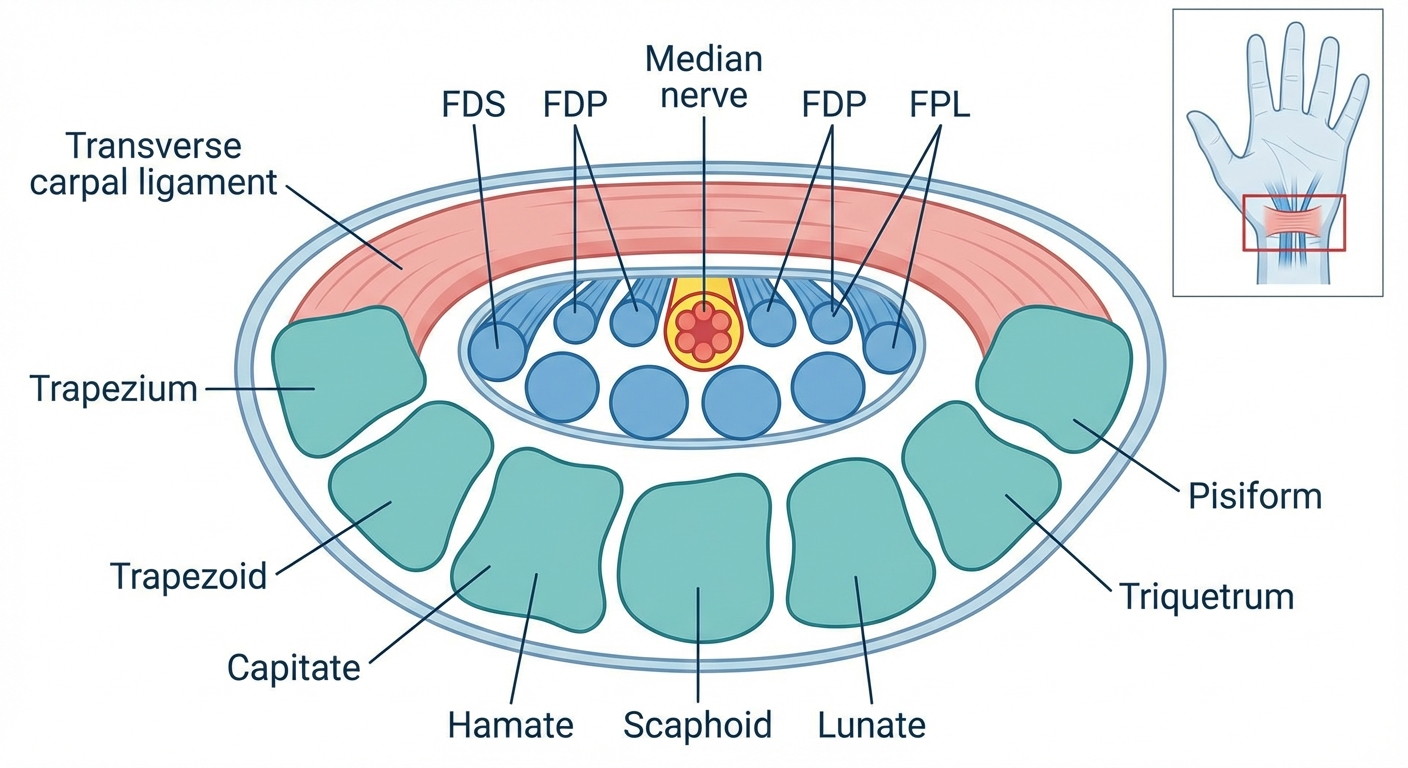
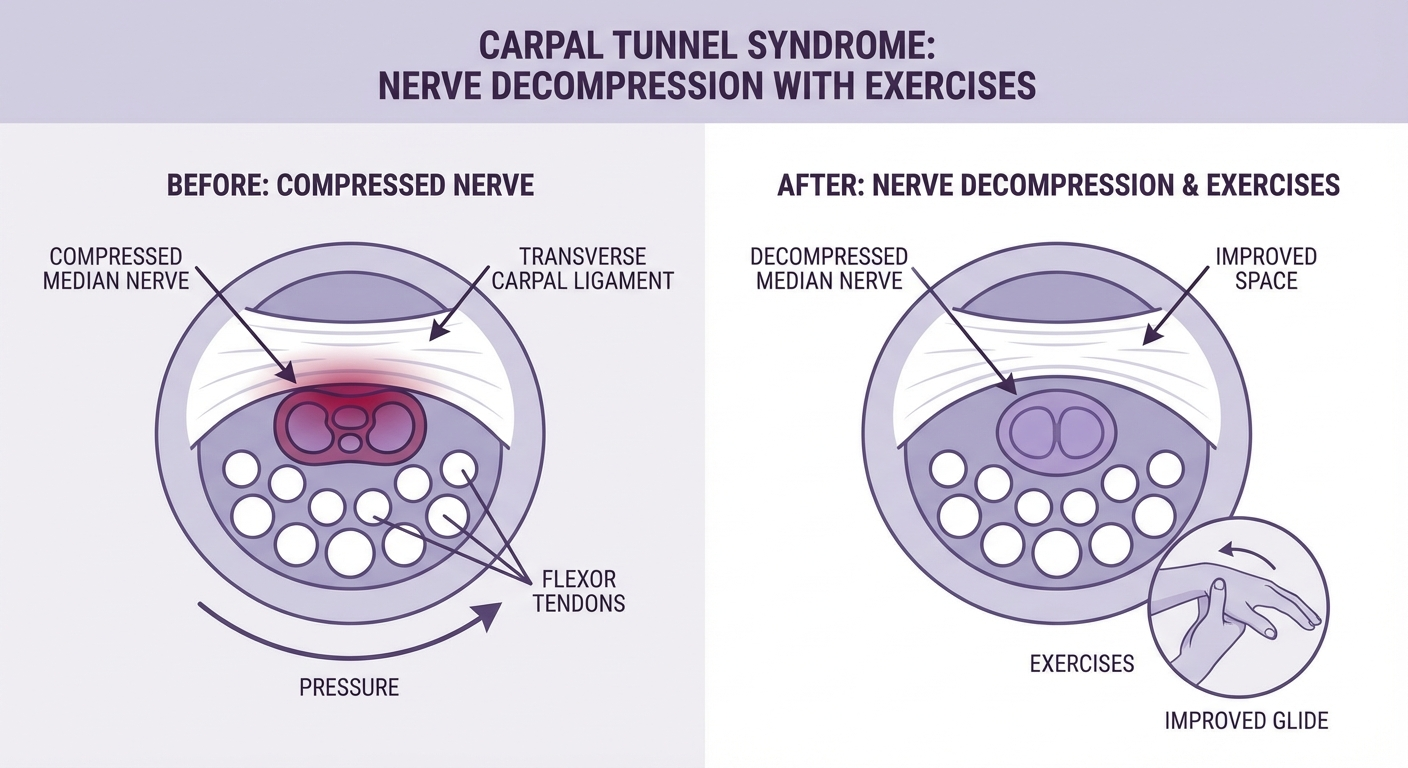
Carpal tunnel syndrome (CTS) occurs when the median nerve — one of the major nerves running from your forearm into your hand — gets compressed as it passes through a narrow passageway called the carpal tunnel. This tunnel is formed by wrist bones on three sides and a tough band of connective tissue called the transverse carpal ligament on the palm side.
When the tendons inside the carpal tunnel swell or the tunnel itself narrows, the median nerve gets squeezed. That's what causes the hallmark symptoms: tingling, numbness, and pain in the thumb, index finger, middle finger, and half of the ring finger. Over time, you might notice weaker grip strength or start dropping things more often.
According to the American Academy of Orthopaedic Surgeons (AAOS), carpal tunnel syndrome affects roughly 3 to 6 percent of adults in the general population. It's one of the most common nerve compression disorders, and office workers who type for extended periods are at elevated risk.
The good news? Not everyone with carpal tunnel needs surgery. Research consistently shows that conservative treatments — including targeted exercises, bracing, and ergonomic adjustments — can significantly reduce symptoms in mild to moderate cases. That's where carpal tunnel exercises come in, and it's exactly what we focus on here at WristWorkGuide.
If you're unsure whether your symptoms point to carpal tunnel or a different condition, check out our detailed comparison of carpal tunnel vs tendonitis for help telling them apart.
How Exercises Help Carpal Tunnel
You might wonder: if a nerve is being compressed, how can stretching possibly help? There are three key mechanisms at work.
1. Nerve gliding reduces adhesions. When the median nerve is compressed, it can become "stuck" to surrounding tissues. Nerve gliding exercises (also called nerve flossing) gently mobilize the nerve through the carpal tunnel, breaking up adhesions and restoring smooth movement. A 2012 study published in the Journal of Orthopaedic & Sports Physical Therapy found that nerve gliding exercises produced measurable improvements in nerve conduction velocity in CTS patients.
2. Tendon stretching reduces swelling. Gentle stretching of the wrist flexor and extensor tendons decreases inflammation inside the carpal tunnel. Less swelling means more room for the median nerve, and that translates to less compression and fewer symptoms.
3. Improved blood flow accelerates healing. Movement promotes circulation to the affected area, delivering oxygen and nutrients while carrying away inflammatory waste products. This is especially important for office workers who keep their wrists in a fixed position for hours at a time.
A systematic review published by the National Institutes of Health (NIH) concluded that exercise-based interventions can be as effective as splinting alone for mild CTS, and combining exercises with night splinting produces the best outcomes for moderate cases.
10 Carpal Tunnel Exercises for Quick Relief
These exercises are ordered from gentlest to most involved. If you're in an acute flare-up, start with just the first three or four and add more as your symptoms allow. Never push through sharp pain.
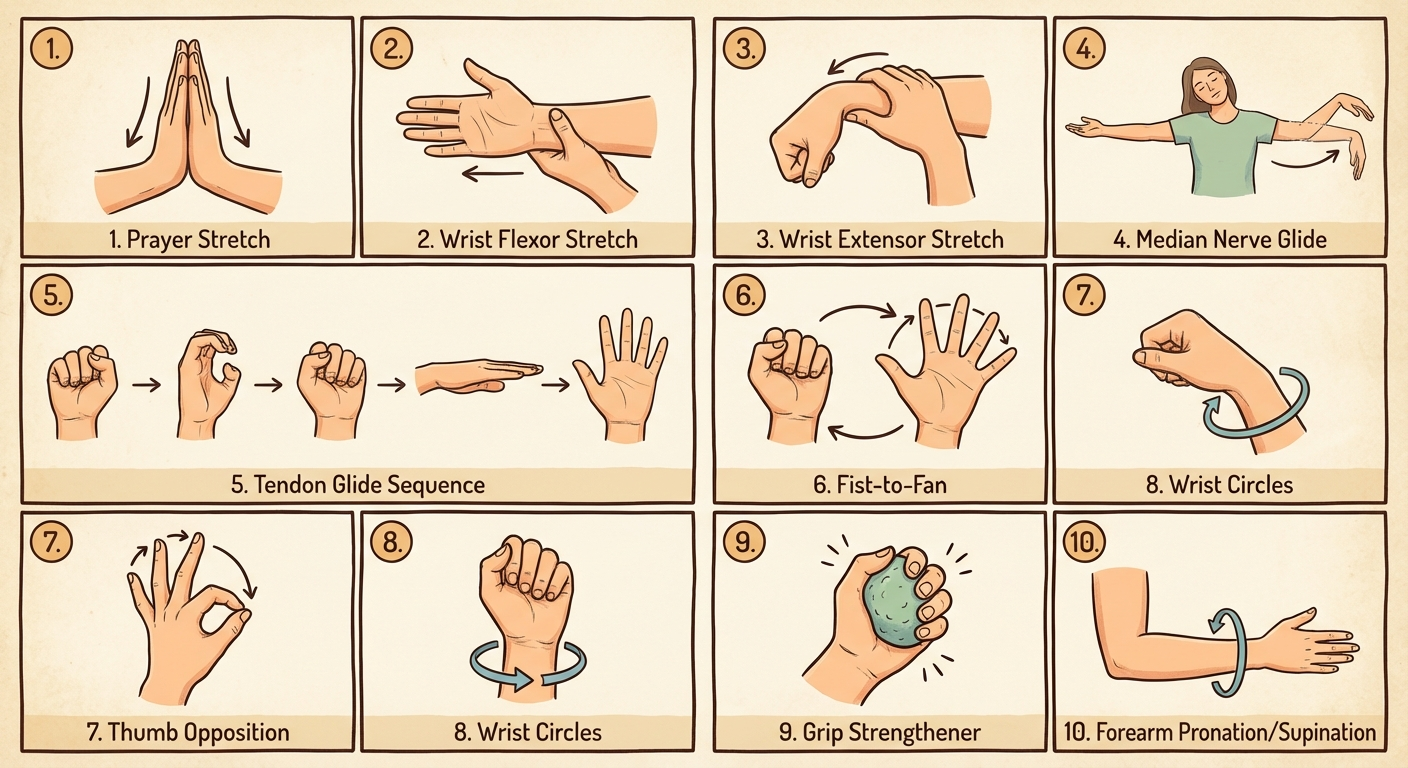
1. Prayer Stretch (Wrist Flexor Stretch)
The prayer stretch is the single most effective starting exercise for carpal tunnel relief. It gently opens the carpal tunnel by stretching the transverse carpal ligament and wrist flexors simultaneously.
How to do it:
- Press your palms together in front of your chest in a prayer position, fingers pointing upward.
- Keeping your palms pressed together, slowly lower your hands toward your waist until you feel a stretch in your wrists and forearms.
- Hold for 15 to 30 seconds.
- Return to the starting position.
Reps: 3 to 5 holds | Frequency: 2 to 3 times per day
Tip: Keep your elbows out slightly to deepen the stretch. You should feel a mild pull, not pain.
2. Wrist Flexor Stretch
This stretch targets the muscles and tendons on the palm side of your forearm — the same ones that run through the carpal tunnel. By lengthening them, you reduce the pressure they place on the median nerve.
How to do it:
- Extend your right arm in front of you, palm facing up.
- With your left hand, gently pull your right fingers downward (toward the floor) until you feel a stretch along the inner forearm.
- Hold for 15 to 30 seconds.
- Switch arms and repeat.
Reps: 3 holds per arm | Frequency: 2 to 3 times per day
3. Wrist Extensor Stretch
This is the mirror image of the flexor stretch. It targets the muscles on the top of your forearm, which become chronically tight from typing and mouse use.
How to do it:
- Extend your right arm in front of you, palm facing down.
- With your left hand, gently press the back of your right hand downward until you feel a stretch along the outer forearm.
- Hold for 15 to 30 seconds.
- Switch arms and repeat.
Reps: 3 holds per arm | Frequency: 2 to 3 times per day
Why it works: Even though the extensors are on the opposite side, tightness here changes wrist mechanics and can increase pressure inside the carpal tunnel. Keeping both sides flexible is essential.
4. Median Nerve Glide (Nerve Flossing)
This is the most research-backed exercise specifically for carpal tunnel syndrome. Nerve glides gently mobilize the median nerve through the carpal tunnel, preventing adhesions and improving nerve function.
How to do it:
- Start with your arm at your side, elbow bent at 90 degrees, wrist neutral, and fingers curled into a fist.
- Position 1: Extend your fingers so they point straight up, keeping your wrist neutral.
- Position 2: Extend your wrist back (fingers pointing toward the ceiling, palm facing away from you).
- Position 3: Extend your thumb out to the side.
- Position 4: Keeping your arm in position, gently turn your forearm so your palm faces the ceiling.
- Position 5: Use your other hand to gently pull your thumb back slightly.
- Move through each position slowly, holding for 3 to 5 seconds at each stage.
- Return to the starting fist position and repeat.
Reps: 5 full sequences per hand | Frequency: 2 to 3 times per day
Important: Move smoothly and slowly. If tingling increases significantly at any position, stop and back off one stage. The goal is gentle mobilization, not aggressive stretching.
5. Tendon Glide Sequence
Tendon glides move the flexor tendons through the carpal tunnel, preventing them from getting stuck and reducing friction against the median nerve. Research from the Mayo Clinic supports tendon gliding as part of a comprehensive conservative treatment program for CTS.
How to do it:
- Straight: Start with fingers extended straight out, palm facing you.
- Hook: Bend your fingers at the middle and end joints only (like a hook or claw), keeping the big knuckles straight.
- Full Fist: Curl all fingers into a tight fist.
- Tabletop: Bend your fingers at the big knuckles to 90 degrees while keeping fingers straight (flat tabletop shape).
- Straight Fist: Curl fingers into a fist with fingertips touching the top of the palm.
- Return to the straight position and repeat.
Reps: 5 to 10 full sequences per hand | Frequency: 2 to 3 times per day
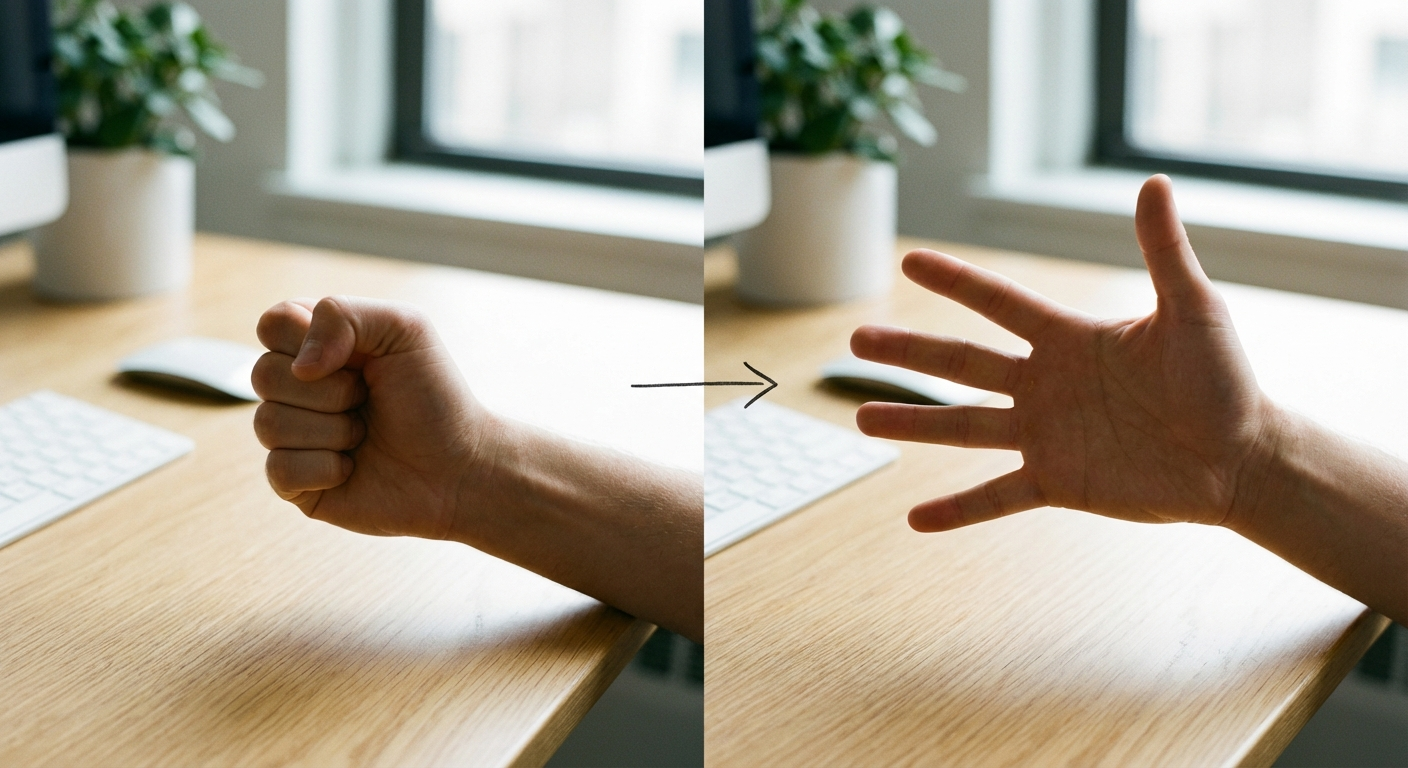
6. Fist-to-Fan Spread
This exercise improves finger mobility and strengthens the small intrinsic muscles of the hand that support proper wrist mechanics.
How to do it:
- Make a tight fist with your thumb wrapped over your fingers.
- In one smooth motion, open your hand wide, spreading all five fingers as far apart as possible (like a fan).
- Hold the open position for 5 seconds, actively pushing your fingers apart.
- Return to a fist and repeat.
Reps: 10 to 15 per hand | Frequency: 2 to 3 times per day
Office-friendly tip: This one is completely silent and can be done under your desk during a meeting without anyone noticing.
7. Thumb Opposition Touch
Thumb weakness is one of the earliest signs of carpal tunnel progression. This exercise maintains dexterity and strengthens the thenar muscles at the base of your thumb.
How to do it:
- Hold your hand in front of you with fingers extended.
- Touch the tip of your thumb to the tip of your index finger, forming an "O" shape.
- Open your hand back to the starting position.
- Touch your thumb to your middle finger.
- Continue through your ring finger and pinky.
- Reverse direction back to the index finger.
Reps: 5 full cycles per hand | Frequency: 2 to 3 times per day
8. Wrist Circles
Wrist circles combine flexion, extension, and lateral movement in one fluid exercise. They are particularly useful as a warm-up before more targeted stretches.
How to do it:
- Extend your arm in front of you with a loose fist.
- Slowly rotate your wrist in a clockwise direction, making the largest circle comfortable.
- Complete 10 circles clockwise.
- Reverse direction for 10 circles counterclockwise.
- Switch hands and repeat.
Reps: 10 circles each direction per hand | Frequency: 2 to 3 times per day
9. Grip Strengthener (Stress Ball Squeeze)
Once your pain is under control, gentle grip strengthening helps stabilize the wrist joint and prevent symptom recurrence. WristWorkGuide recommends starting with a soft resistance ball and progressing gradually.
How to do it:
- Hold a soft stress ball or therapy putty in your hand.
- Squeeze firmly but not maximally — aim for about 50 to 70 percent of your full grip strength.
- Hold the squeeze for 5 seconds.
- Release slowly (don't just let go — control the release).
- Relax for 5 seconds between reps.
Reps: 10 to 15 per hand | Frequency: Once per day (not during flare-ups)
Caution: Skip this exercise if you're experiencing active inflammation, swelling, or increased numbness. Strengthening exercises are for the maintenance phase, not acute symptom management.
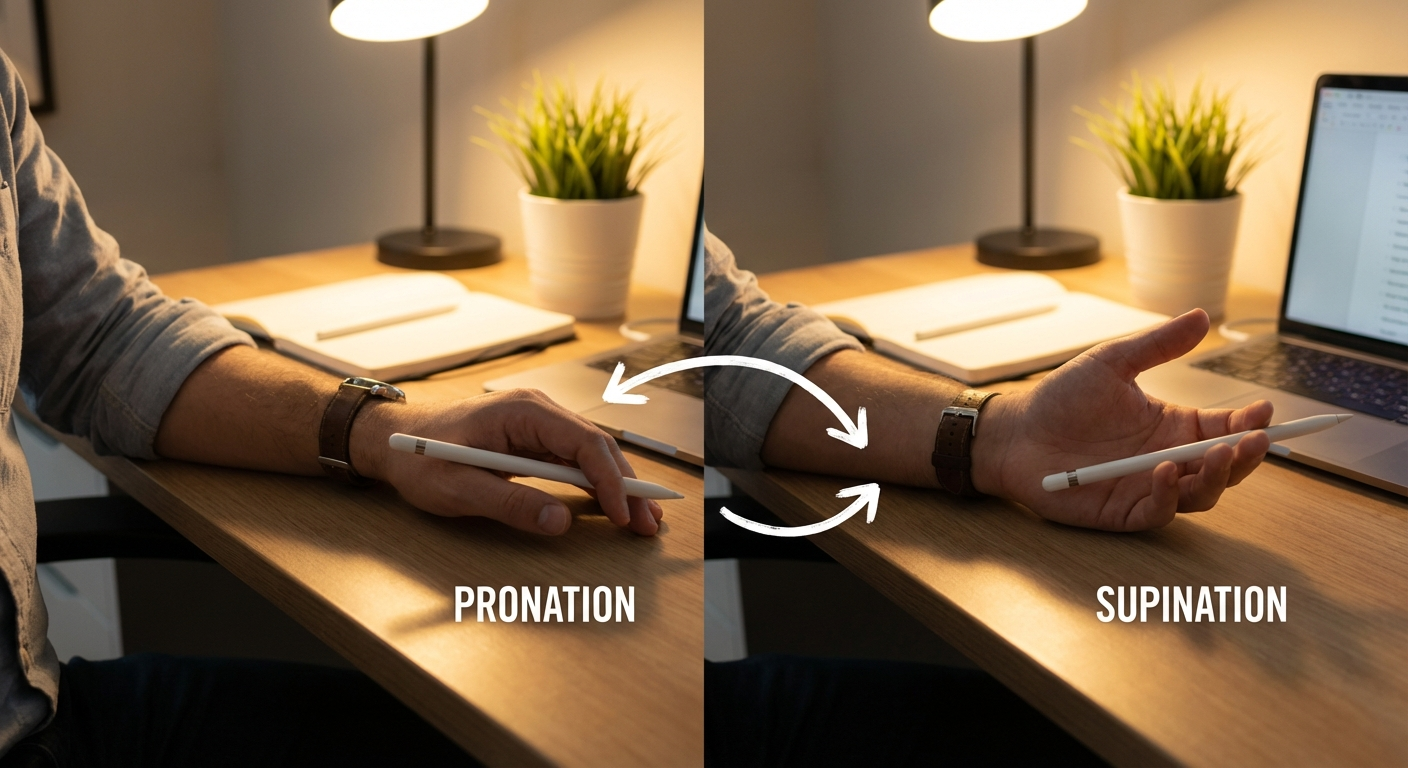
10. Forearm Pronation and Supination
This exercise targets the muscles that rotate your forearm — the same muscles you use constantly when typing, using a mouse, and turning doorknobs. Tightness here contributes to carpal tunnel compression.
How to do it:
- Sit with your forearm resting on your thigh or a table, elbow bent at 90 degrees.
- Hold a light object (a pen or lightweight can) in your hand.
- Slowly rotate your forearm so your palm faces down (pronation).
- Hold for 3 seconds.
- Slowly rotate so your palm faces up (supination).
- Hold for 3 seconds.
Reps: 10 to 15 per arm | Frequency: 2 times per day
Quick Reference: Exercise Summary Table

| # | Exercise | Target Area | Hold / Reps | Frequency | Difficulty |
|---|---|---|---|---|---|
| 1 | Prayer Stretch | Wrist flexors, carpal ligament | 15-30s × 3-5 | 2-3x/day | Easy |
| 2 | Wrist Flexor Stretch | Inner forearm muscles | 15-30s × 3/arm | 2-3x/day | Easy |
| 3 | Wrist Extensor Stretch | Outer forearm muscles | 15-30s × 3/arm | 2-3x/day | Easy |
| 4 | Median Nerve Glide | Median nerve | 5 sequences/hand | 2-3x/day | Moderate |
| 5 | Tendon Glide Sequence | Flexor tendons | 5-10 sequences/hand | 2-3x/day | Moderate |
| 6 | Fist-to-Fan Spread | Hand intrinsics, finger mobility | 10-15 reps/hand | 2-3x/day | Easy |
| 7 | Thumb Opposition Touch | Thenar muscles, dexterity | 5 cycles/hand | 2-3x/day | Easy |
| 8 | Wrist Circles | Full wrist range of motion | 10 each direction | 2-3x/day | Easy |
| 9 | Grip Strengthener | Grip muscles, wrist stabilizers | 10-15 reps/hand | 1x/day | Moderate |
| 10 | Forearm Pronation/Supination | Forearm rotators | 10-15 reps/arm | 2x/day | Easy |
Full routine time: Approximately 8 to 12 minutes per session.
Exercises for Desk Workers
If you spend hours typing, targeted desk-specific exercises can provide extra relief. These exercises address the unique biomechanical challenges of office work.
Desk Press Wrist Extension
This exercise uses your desk as a tool for a controlled wrist extension stretch. It is particularly effective for people who find the prayer stretch difficult.
How to do it:
- Stand up and place both palms flat on your desk, fingers pointing toward your monitor.
- Keeping your palms flat, slowly lean forward until you feel a moderate stretch in your wrists and forearms.
- Hold for 15 to 20 seconds.
- Rock gently from side to side 5 times while maintaining the stretch.
Reps: 3 holds | Frequency: 2 to 3 times per day during standing breaks
Shoulder Roll and Neck Release
The median nerve originates in the cervical spine and runs through the shoulder before reaching the wrist. Tension in the neck and shoulders can create a "double crush" effect where the nerve is compressed at multiple points.
How to do it:
- Sit up straight in your chair with your feet flat on the floor.
- Roll both shoulders backward in large circles — 10 rolls.
- Roll both shoulders forward — 10 rolls.
- Tilt your head slowly to the right, bringing your ear toward your shoulder. Hold 15 seconds.
- Repeat on the left side.
- Gently tuck your chin toward your chest and hold 10 seconds.
Frequency: Every 90 minutes or whenever you notice neck tension
Desk Exercise Schedule for Office Workers
| Time | Exercises | Duration |
|---|---|---|
| Morning warm-up | Prayer stretch, wrist circles, flexor/extensor stretches | 3 minutes |
| Every 60–90 min | Prayer stretch, nerve glide, fist-to-fan | Under 2 minutes |
| Lunch break | Full routine (all 10 exercises) | 8–12 minutes |
| End of day | Prayer stretch, flexor stretch, nerve glide, shoulder rolls | 4 minutes |
A study published in the Journal of Occupational Rehabilitation found that workers who took structured micro-breaks for wrist exercises reported 37% fewer symptom flare-ups compared to those who only stretched during designated break times.
Stop Guessing. Follow the System That Actually Works.
The exact protocol backed by physical therapy research — not random stretches from Google.
Get My Complete Carpal Tunnel Recovery Guide — $7Instant download • 30-day money-back guarantee
When to Do These Exercises
Timing matters almost as much as the exercises themselves. Here's when carpal tunnel exercises deliver the most benefit:
Morning (Before Work)
Start your day with exercises 1 through 3 (the three stretches) and exercise 8 (wrist circles). This loosens overnight stiffness — especially important if you sleep in a wrist brace. Total time: about 3 minutes.
Midday (Lunch Break)
Run through the full routine of all 10 exercises. Your lunch break is the best time for the complete sequence because you can give each exercise proper attention without feeling rushed. Total time: 8 to 12 minutes.
Every 60 to 90 Minutes (Micro-Breaks)
The most overlooked strategy is also the most effective. Set a timer and do exercises 1, 4, and 6 (prayer stretch, nerve glide, and fist-to-fan) every 60 to 90 minutes during your workday. These three exercises take under 2 minutes combined and prevent the cumulative compression that builds throughout the day.
According to a study published in the Journal of Occupational Rehabilitation, workers who took structured micro-breaks for wrist exercises reported 37 percent fewer symptom flare-ups compared to those who only stretched during designated break times.
Before Bed
If you wear a night brace (and if you have carpal tunnel symptoms during sleep, you should — see our guide to the best wrist brace for carpal tunnel), do exercises 1, 2, and 4 right before putting the brace on. This ensures the nerve is in its best position before your wrist is immobilized for the night.
Heat vs. Ice: Which One Should You Use?
This is one of the most common questions we get at WristWorkGuide, and the answer depends on timing.
Use Heat Before Exercises
Apply a warm towel, warm water soak, or microwaveable heat wrap to your wrists and forearms for 15 to 20 minutes before your exercise session. Heat increases blood flow, relaxes tight muscles, and makes tissues more pliable — which means you'll get more out of each stretch.
Best options: A warm water soak in the sink, microwaveable rice sock, or a reusable wrist heat wrap.
Use Ice After Activity
Apply a cold pack wrapped in a thin towel to your wrists for 10 to 15 minutes after extended typing sessions or whenever symptoms flare up. Cold therapy reduces inflammation and numbs pain signals.
Best options: Gel ice packs that conform to the wrist, or a simple bag of frozen peas wrapped in a dish towel.
Contrast Therapy
Some patients find alternating between heat and cold — 3 minutes warm, 1 minute cold, repeated 3 times — provides the best relief. This "contrast therapy" approach pumps blood in and out of the area, which can accelerate healing. Always end on cold if your symptoms include swelling.
Key rule: Never apply heat or ice directly to skin. Always use a barrier layer to prevent burns or frostbite.
Recommended Products for Carpal Tunnel Relief
The right support products can amplify the benefits of your exercise routine. Here are the categories that make the biggest difference for carpal tunnel management.
Wrist Braces for Night Use
Wearing a wrist brace at night keeps your wrist in a neutral position and prevents the flexed sleeping posture that compresses the median nerve. The AAOS recommends night splinting as a first-line conservative treatment for CTS.
Look for a brace with a rigid or semi-rigid palmar stay that holds your wrist at 0 to 15 degrees of extension, breathable materials for overnight comfort, and adjustable straps that won't cut off circulation.
We've tested and reviewed over 20 options in our comprehensive guide to the best wrist brace for carpal tunnel.
Ergonomic Keyboards
An ergonomic keyboard addresses one of the root causes of carpal tunnel syndrome: sustained wrist pronation and ulnar deviation during typing. Split keyboards and tented keyboards allow your wrists to rest in a more natural position, reducing strain on the carpal tunnel throughout the entire workday.
Key features to look for include a split or angled design, negative tilt capability (front edge higher than back), integrated palm rests at the correct height, and mechanical or low-force keys that reduce finger strain.
Therapy Putty and Grip Strengtheners
For exercise 9 (grip strengthener), a proper therapy putty or graduated hand exerciser gives you more control over resistance than a generic stress ball. Look for sets with multiple resistance levels so you can progress as your strength improves.
When Exercises Aren't Enough: Warning Signs
Carpal tunnel exercises are a powerful tool for mild to moderate symptoms, but they aren't a substitute for medical treatment when the condition has progressed. See a healthcare provider promptly if you experience any of the following:
- Constant numbness that doesn't come and go — this suggests sustained nerve compression.
- Thenar atrophy — visible wasting or flattening of the muscle pad at the base of your thumb.
- Weakness that causes you to drop objects regularly.
- Night symptoms that wake you more than 3 to 4 times per week despite wearing a brace.
- No improvement after 4 to 6 weeks of consistent daily exercises and bracing.
- Symptoms in both hands that are worsening progressively.
Early intervention matters. The longer the median nerve is compressed, the more difficult full recovery becomes. Your doctor may recommend nerve conduction studies, corticosteroid injections, or in advanced cases, carpal tunnel release surgery. Even if you need medical intervention, continuing your exercise routine during and after treatment improves outcomes.
If you're not sure whether your symptoms are CTS or something else — carpal tunnel vs tendonitis is a common source of confusion — get a proper diagnosis before committing to any treatment plan.
FAQ
How often should I do carpal tunnel exercises?
Perform carpal tunnel exercises 2 to 3 times per day for the best results. Each session takes about 5 to 10 minutes. Consistency matters more than duration — short, frequent sessions throughout the workday are more effective than one long session. Ideally, add micro-break stretches every 60 to 90 minutes during computer work for the best long-term symptom management.
Can exercises cure carpal tunnel syndrome?
Exercises alone may not cure carpal tunnel syndrome, but research shows they can significantly reduce symptoms and slow progression in mild to moderate cases. A 2019 study in the Journal of Orthopaedic & Sports Physical Therapy found that nerve gliding exercises combined with splinting reduced surgery rates by up to 40 percent. For best results, combine exercises with night bracing and ergonomic adjustments to your workspace.
Should I exercise if my hands feel numb?
Mild numbness during gentle stretching is common and generally safe. However, stop immediately if numbness worsens during an exercise, you feel sharp or shooting pain, or symptoms spread up your arm. These could indicate nerve compression that requires medical evaluation. Always start with the gentlest exercises (prayer stretch, wrist flexor stretch) and progress gradually as tolerated.
What is the difference between carpal tunnel and tendonitis?
Carpal tunnel syndrome involves compression of the median nerve, causing numbness, tingling, and weakness primarily in the thumb, index, and middle fingers. Tendonitis involves inflammation of the tendons, causing localized pain and tenderness along the affected tendon rather than nerve symptoms like tingling. The exercise approaches differ significantly for each condition, so accurate diagnosis matters. Read our full breakdown of carpal tunnel vs tendonitis for detailed guidance.
When should I see a doctor for carpal tunnel?
See a doctor if your symptoms persist for more than two weeks despite consistent home treatment, you experience constant numbness rather than intermittent episodes, you frequently drop objects, you notice visible muscle wasting at the base of your thumb, or your symptoms regularly interfere with sleep despite wearing a night brace. According to the AAOS, early diagnosis and treatment lead to significantly better long-term outcomes.
Is it better to use heat or ice for carpal tunnel?
Both have their place. Use heat (15 to 20 minutes) before exercises to increase blood flow and tissue flexibility. Use ice (10 to 15 minutes) after repetitive activities or during symptom flare-ups to reduce inflammation. Many patients benefit from contrast therapy — alternating between warm and cold applications. Always use a barrier between the heat or ice source and your skin to prevent tissue damage.
Sources
-
American Academy of Orthopaedic Surgeons (AAOS). "Carpal Tunnel Syndrome." OrthoInfo. https://orthoinfo.aaos.org/en/diseases--conditions/carpal-tunnel-syndrome/
-
Ballestero-Pérez, R., et al. "Effectiveness of Nerve Gliding Exercises on Carpal Tunnel Syndrome: A Systematic Review." Journal of Manipulative and Physiological Therapeutics, vol. 40, no. 1, 2017, pp. 50-59. https://pubmed.ncbi.nlm.nih.gov/27903443/
-
Mayo Clinic. "Carpal Tunnel Syndrome — Diagnosis and Treatment." https://www.mayoclinic.org/diseases-conditions/carpal-tunnel-syndrome/diagnosis-treatment/drc-20355608
-
Fernández-de-las-Peñas, C., et al. "Manual Therapy Versus Surgery for Carpal Tunnel Syndrome: 4-Year Follow-Up From a Randomized Controlled Trial." Physical Therapy, vol. 100, no. 11, 2020, pp. 1987-1996. https://pubmed.ncbi.nlm.nih.gov/32789463/
-
National Institute of Neurological Disorders and Stroke (NINDS). "Carpal Tunnel Syndrome Fact Sheet." National Institutes of Health. https://www.ninds.nih.gov/health-information/disorders/carpal-tunnel-syndrome
This article is for informational purposes only and does not constitute medical advice. Always consult a qualified healthcare professional before starting any new exercise program, especially if you have been diagnosed with carpal tunnel syndrome or are experiencing severe symptoms. WristWorkGuide is committed to providing evidence-based guidance for wrist health and RSI prevention.
Visual Guide Gallery

Get the Complete Carpal Tunnel Recovery Guide — Same System That Helped Thousands
40+ pages of exercises, protocols, and the complete recovery plan. Instant download, 30-day money-back guarantee.
Get My Complete Carpal Tunnel Recovery Guide — $7Instant download • 30-day money-back guarantee