Guide
Carpal Tunnel vs Cervical Radiculopathy
By Carpal Tunnel Guide Editorial Team · Updated 2026-08-10
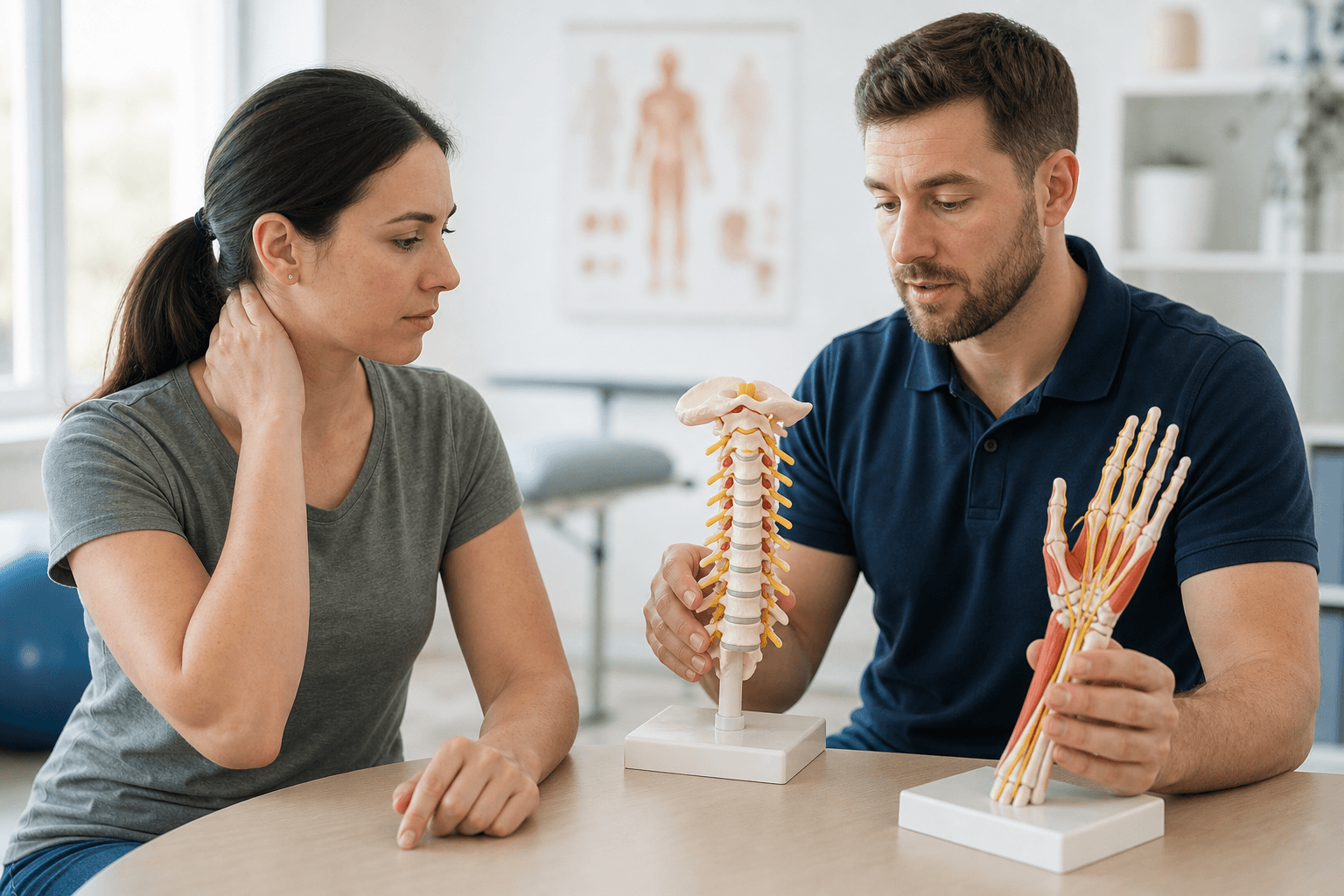
Carpal tunnel syndrome compresses the median nerve at the wrist, while cervical radiculopathy involves a nerve root in the neck. Finger distribution, neck or shoulder symptoms, weakness pattern, and testing may help clinicians distinguish them, but overlap and simultaneous conditions are possible.
Medical boundary: This page is general education. It cannot diagnose the cause or severity of hand symptoms. New major weakness, sudden neurological change, severe trauma, or rapidly worsening function needs prompt professional assessment.
Quick answer
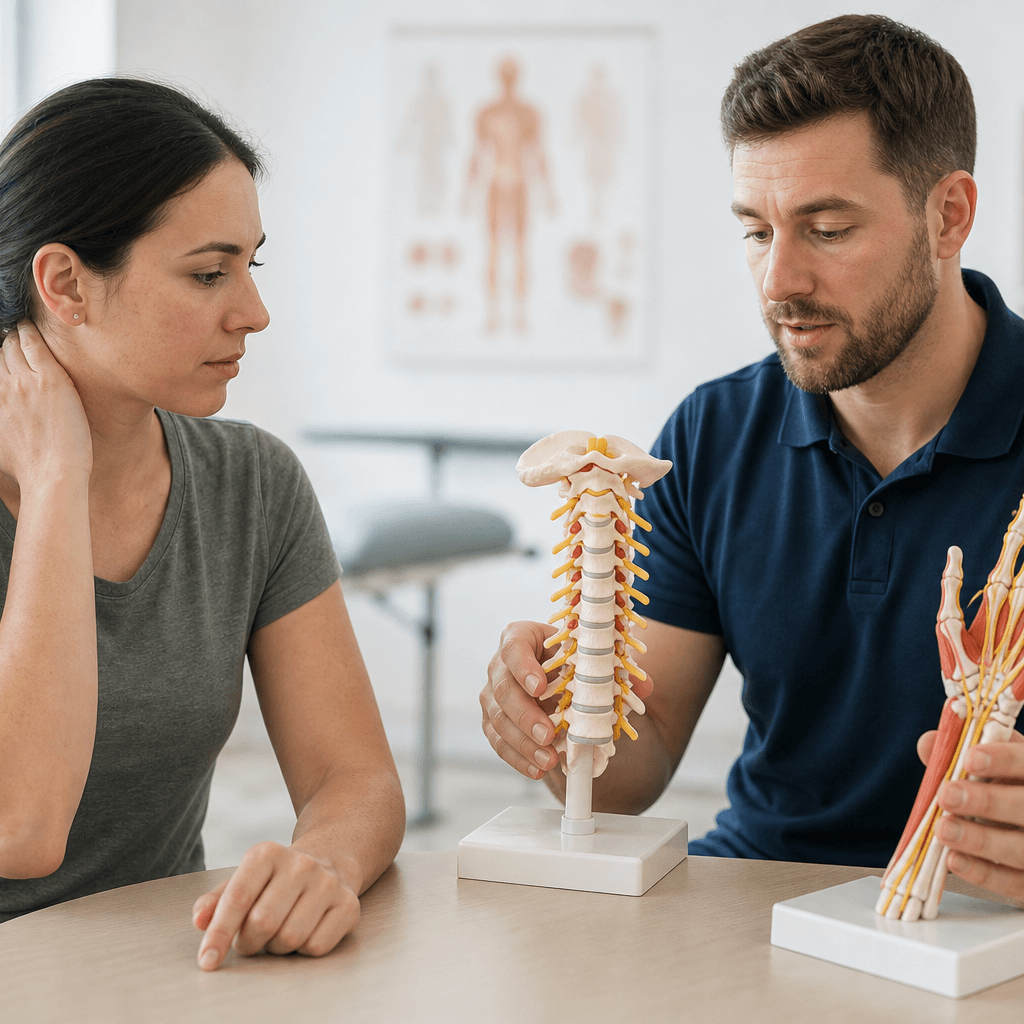
Carpal tunnel syndrome compresses the median nerve at the wrist, while cervical radiculopathy involves a nerve root in the neck. Finger distribution, neck or shoulder symptoms, weakness pattern, and testing may help clinicians distinguish them, but overlap and simultaneous conditions are possible. The most useful next step is to document distribution, timing, progression, triggers, and functional change, then use that record in an appropriate clinical or workplace assessment. Avoid treating a product trial, online maneuver, or one test result as proof.
How to use this guide
Read the sections that match your decision, then write down only the observations that apply. Keep medical questions separate from equipment questions: diagnosis and treatment belong with qualified health professionals, while equipment choices should be based on task fit, compatibility, adjustability, and a reversible trial.
Two different locations along a nerve pathway
A wrist-level compression and a neck-level nerve-root problem occur at different anatomical sites. Location changes the pattern a clinician expects, but symptom descriptions alone are not always precise enough to localize the problem.
A useful way to interpret this section is to separate observation from conclusion. For carpal tunnel vs cervical radiculopathy, describe the exact situation rather than using a broad label. A clinician, ergonomist, or workplace professional can work with a clear pattern; they cannot reliably reconstruct it from a conclusion such as “it is definitely carpal tunnel.” The practical question is not whether one clue is present, but how the clues fit together.
What to observe
- Wrist-level symptoms: What did you notice, what were you doing, how long did it last, and what happened when the task or position changed?
- Neck-level symptoms: What did you notice, what were you doing, how long did it last, and what happened when the task or position changed?
- Arm radiation: What did you notice, what were you doing, how long did it last, and what happened when the task or position changed?
- Finger distribution: What did you notice, what were you doing, how long did it last, and what happened when the task or position changed?
- Overlap: What did you notice, what were you doing, how long did it last, and what happened when the task or position changed?
Observation should be proportionate. Do not repeatedly provoke pain, force a joint, hold a sustained position, or use sharp objects to compare sensation. Include ordinary activities, symptom-free periods, and differences between right and left. A short record made during normal life is generally more useful than an aggressive home test.
Decision table
| Observation | Useful context to capture | Reasonable next step |
|---|---|---|
| Wrist-level symptoms | Describe when, where, and how consistently it occurs; include a symptom-free comparison when possible. | Map the full route; escalate sooner if function or safety is changing. |
| Neck-level symptoms | Describe when, where, and how consistently it occurs; include a symptom-free comparison when possible. | Include shoulder and neck; escalate sooner if function or safety is changing. |
| Arm radiation | Describe when, where, and how consistently it occurs; include a symptom-free comparison when possible. | Avoid choosing one label; escalate sooner if function or safety is changing. |
| Finger distribution | Describe when, where, and how consistently it occurs; include a symptom-free comparison when possible. | Seek examination; escalate sooner if function or safety is changing. |
| Overlap | Describe when, where, and how consistently it occurs; include a symptom-free comparison when possible. | Map the full route; escalate sooner if function or safety is changing. |
Apply the information carefully
- Map the full route. Tie this action to a specific observation and a review point. If it does not improve the intended exposure, clarity, or safe function, reconsider it instead of adding more unsupported assumptions.
- Include shoulder and neck. Tie this action to a specific observation and a review point. If it does not improve the intended exposure, clarity, or safe function, reconsider it instead of adding more unsupported assumptions.
- Avoid choosing one label. Tie this action to a specific observation and a review point. If it does not improve the intended exposure, clarity, or safe function, reconsider it instead of adding more unsupported assumptions.
- Seek examination. Tie this action to a specific observation and a review point. If it does not improve the intended exposure, clarity, or safe function, reconsider it instead of adding more unsupported assumptions.
A response to an activity change or piece of equipment is not a diagnostic test. Symptoms naturally fluctuate, and expectation, workload, sleep, general health, and adaptation can all influence a short trial. Record both benefits and tradeoffs. Persistent numbness, progressive weakness, visible muscle change, or a broader neurological pattern warrants professional assessment regardless of whether a temporary adjustment feels helpful.
Typical carpal tunnel clues
CTS commonly affects median-nerve fingers and may wake a person at night or appear during sustained wrist and hand positions. Symptoms can radiate upward, which is why forearm discomfort alone does not prove a neck source.
This distinction protects against overconfidence from a single symptom or product label. For carpal tunnel vs cervical radiculopathy, describe the exact situation rather than using a broad label. A clinician, ergonomist, or workplace professional can work with a clear pattern; they cannot reliably reconstruct it from a conclusion such as “it is definitely carpal tunnel.” Use the pattern to prepare better questions, not to replace an examination.
What to observe
- Thumb-index-middle pattern: What did you notice, what were you doing, how long did it last, and what happened when the task or position changed?
- Night waking: What did you notice, what were you doing, how long did it last, and what happened when the task or position changed?
- Hand shaking: What did you notice, what were you doing, how long did it last, and what happened when the task or position changed?
- Phone or driving trigger: What did you notice, what were you doing, how long did it last, and what happened when the task or position changed?
- Thenar weakness: What did you notice, what were you doing, how long did it last, and what happened when the task or position changed?
Observation should be proportionate. Do not repeatedly provoke pain, force a joint, hold a sustained position, or use sharp objects to compare sensation. Include ordinary activities, symptom-free periods, and differences between right and left. A short record made during normal life is generally more useful than an aggressive home test.
Decision table
| Observation | Useful context to capture | Reasonable next step |
|---|---|---|
| Thumb-index-middle pattern | Describe when, where, and how consistently it occurs; include a symptom-free comparison when possible. | Record wrist context; escalate sooner if function or safety is changing. |
| Night waking | Describe when, where, and how consistently it occurs; include a symptom-free comparison when possible. | Note little finger; escalate sooner if function or safety is changing. |
| Hand shaking | Describe when, where, and how consistently it occurs; include a symptom-free comparison when possible. | Describe sleep effect; escalate sooner if function or safety is changing. |
| Phone or driving trigger | Describe when, where, and how consistently it occurs; include a symptom-free comparison when possible. | Mention constant numbness; escalate sooner if function or safety is changing. |
| Thenar weakness | Describe when, where, and how consistently it occurs; include a symptom-free comparison when possible. | Record wrist context; escalate sooner if function or safety is changing. |
Apply the information carefully
- Record wrist context. Tie this action to a specific observation and a review point. If it does not improve the intended exposure, clarity, or safe function, reconsider it instead of adding more unsupported assumptions.
- Note little finger. Tie this action to a specific observation and a review point. If it does not improve the intended exposure, clarity, or safe function, reconsider it instead of adding more unsupported assumptions.
- Describe sleep effect. Tie this action to a specific observation and a review point. If it does not improve the intended exposure, clarity, or safe function, reconsider it instead of adding more unsupported assumptions.
- Mention constant numbness. Tie this action to a specific observation and a review point. If it does not improve the intended exposure, clarity, or safe function, reconsider it instead of adding more unsupported assumptions.
A response to an activity change or piece of equipment is not a diagnostic test. Symptoms naturally fluctuate, and expectation, workload, sleep, general health, and adaptation can all influence a short trial. Record both benefits and tradeoffs. Persistent numbness, progressive weakness, visible muscle change, or a broader neurological pattern warrants professional assessment regardless of whether a temporary adjustment feels helpful.
Typical cervical clues
A neck source may include neck pain, shoulder or arm symptoms, reflex changes, or weakness that follows a nerve-root pattern. Some people have little neck pain, so absence of pain does not settle the question.
Context changes the meaning of the same observation. For carpal tunnel vs cervical radiculopathy, describe the exact situation rather than using a broad label. A clinician, ergonomist, or workplace professional can work with a clear pattern; they cannot reliably reconstruct it from a conclusion such as “it is definitely carpal tunnel.” Timing, distribution, progression, and function are therefore recorded together.
What to observe
- Neck movement association: What did you notice, what were you doing, how long did it last, and what happened when the task or position changed?
- Shoulder blade pain: What did you notice, what were you doing, how long did it last, and what happened when the task or position changed?
- Arm radiation: What did you notice, what were you doing, how long did it last, and what happened when the task or position changed?
- Reflex change: What did you notice, what were you doing, how long did it last, and what happened when the task or position changed?
- Broader weakness: What did you notice, what were you doing, how long did it last, and what happened when the task or position changed?
Observation should be proportionate. Do not repeatedly provoke pain, force a joint, hold a sustained position, or use sharp objects to compare sensation. Include ordinary activities, symptom-free periods, and differences between right and left. A short record made during normal life is generally more useful than an aggressive home test.
Decision table
| Observation | Useful context to capture | Reasonable next step |
|---|---|---|
| Neck movement association | Describe when, where, and how consistently it occurs; include a symptom-free comparison when possible. | Note neck positions; escalate sooner if function or safety is changing. |
| Shoulder blade pain | Describe when, where, and how consistently it occurs; include a symptom-free comparison when possible. | Describe arm route; escalate sooner if function or safety is changing. |
| Arm radiation | Describe when, where, and how consistently it occurs; include a symptom-free comparison when possible. | Report balance or gait change; escalate sooner if function or safety is changing. |
| Reflex change | Describe when, where, and how consistently it occurs; include a symptom-free comparison when possible. | Avoid forceful neck tests; escalate sooner if function or safety is changing. |
| Broader weakness | Describe when, where, and how consistently it occurs; include a symptom-free comparison when possible. | Note neck positions; escalate sooner if function or safety is changing. |
Apply the information carefully
- Note neck positions. Tie this action to a specific observation and a review point. If it does not improve the intended exposure, clarity, or safe function, reconsider it instead of adding more unsupported assumptions.
- Describe arm route. Tie this action to a specific observation and a review point. If it does not improve the intended exposure, clarity, or safe function, reconsider it instead of adding more unsupported assumptions.
- Report balance or gait change. Tie this action to a specific observation and a review point. If it does not improve the intended exposure, clarity, or safe function, reconsider it instead of adding more unsupported assumptions.
- Avoid forceful neck tests. Tie this action to a specific observation and a review point. If it does not improve the intended exposure, clarity, or safe function, reconsider it instead of adding more unsupported assumptions.
A response to an activity change or piece of equipment is not a diagnostic test. Symptoms naturally fluctuate, and expectation, workload, sleep, general health, and adaptation can all influence a short trial. Record both benefits and tradeoffs. Persistent numbness, progressive weakness, visible muscle change, or a broader neurological pattern warrants professional assessment regardless of whether a temporary adjustment feels helpful.
Why symptom maps overlap
Nerve territories overlap, people use broad words such as whole-hand numbness, and pain can spread beyond a textbook map. Diabetes or other neuropathy can add another layer, and two conditions can coexist.
The safest approach is specific, reversible, and reviewable. For carpal tunnel vs cervical radiculopathy, describe the exact situation rather than using a broad label. A clinician, ergonomist, or workplace professional can work with a clear pattern; they cannot reliably reconstruct it from a conclusion such as “it is definitely carpal tunnel.” If the working explanation stops fitting, the plan should be reconsidered.
What to observe
- Whole-hand report: What did you notice, what were you doing, how long did it last, and what happened when the task or position changed?
- Mixed fingers: What did you notice, what were you doing, how long did it last, and what happened when the task or position changed?
- Bilateral symptoms: What did you notice, what were you doing, how long did it last, and what happened when the task or position changed?
- Diabetes context: What did you notice, what were you doing, how long did it last, and what happened when the task or position changed?
- Double pathology: What did you notice, what were you doing, how long did it last, and what happened when the task or position changed?
Observation should be proportionate. Do not repeatedly provoke pain, force a joint, hold a sustained position, or use sharp objects to compare sensation. Include ordinary activities, symptom-free periods, and differences between right and left. A short record made during normal life is generally more useful than an aggressive home test.
Decision table
| Observation | Useful context to capture | Reasonable next step |
|---|---|---|
| Whole-hand report | Describe when, where, and how consistently it occurs; include a symptom-free comparison when possible. | Preserve uncertainty; escalate sooner if function or safety is changing. |
| Mixed fingers | Describe when, where, and how consistently it occurs; include a symptom-free comparison when possible. | Compare sides; escalate sooner if function or safety is changing. |
| Bilateral symptoms | Describe when, where, and how consistently it occurs; include a symptom-free comparison when possible. | List medical context; escalate sooner if function or safety is changing. |
| Diabetes context | Describe when, where, and how consistently it occurs; include a symptom-free comparison when possible. | Ask about competing explanations; escalate sooner if function or safety is changing. |
| Double pathology | Describe when, where, and how consistently it occurs; include a symptom-free comparison when possible. | Preserve uncertainty; escalate sooner if function or safety is changing. |
Apply the information carefully
- Preserve uncertainty. Tie this action to a specific observation and a review point. If it does not improve the intended exposure, clarity, or safe function, reconsider it instead of adding more unsupported assumptions.
- Compare sides. Tie this action to a specific observation and a review point. If it does not improve the intended exposure, clarity, or safe function, reconsider it instead of adding more unsupported assumptions.
- List medical context. Tie this action to a specific observation and a review point. If it does not improve the intended exposure, clarity, or safe function, reconsider it instead of adding more unsupported assumptions.
- Ask about competing explanations. Tie this action to a specific observation and a review point. If it does not improve the intended exposure, clarity, or safe function, reconsider it instead of adding more unsupported assumptions.
A response to an activity change or piece of equipment is not a diagnostic test. Symptoms naturally fluctuate, and expectation, workload, sleep, general health, and adaptation can all influence a short trial. Record both benefits and tradeoffs. Persistent numbness, progressive weakness, visible muscle change, or a broader neurological pattern warrants professional assessment regardless of whether a temporary adjustment feels helpful.
Examination and testing
A clinician may examine neck, shoulder, elbow, wrist, sensation, strength, and reflexes. Electrodiagnostic testing can sometimes help localize a lesion, while imaging is chosen for a specific clinical question.
A useful way to interpret this section is to separate observation from conclusion. For carpal tunnel vs cervical radiculopathy, describe the exact situation rather than using a broad label. A clinician, ergonomist, or workplace professional can work with a clear pattern; they cannot reliably reconstruct it from a conclusion such as “it is definitely carpal tunnel.” The practical question is not whether one clue is present, but how the clues fit together.
What to observe
- Neck examination: What did you notice, what were you doing, how long did it last, and what happened when the task or position changed?
- Reflexes: What did you notice, what were you doing, how long did it last, and what happened when the task or position changed?
- Thumb strength: What did you notice, what were you doing, how long did it last, and what happened when the task or position changed?
- Sensory testing: What did you notice, what were you doing, how long did it last, and what happened when the task or position changed?
- Nerve conduction: What did you notice, what were you doing, how long did it last, and what happened when the task or position changed?
Observation should be proportionate. Do not repeatedly provoke pain, force a joint, hold a sustained position, or use sharp objects to compare sensation. Include ordinary activities, symptom-free periods, and differences between right and left. A short record made during normal life is generally more useful than an aggressive home test.
Decision table
| Observation | Useful context to capture | Reasonable next step |
|---|---|---|
| Neck examination | Describe when, where, and how consistently it occurs; include a symptom-free comparison when possible. | Ask what each test localizes; escalate sooner if function or safety is changing. |
| Reflexes | Describe when, where, and how consistently it occurs; include a symptom-free comparison when possible. | Avoid home provocation; escalate sooner if function or safety is changing. |
| Thumb strength | Describe when, where, and how consistently it occurs; include a symptom-free comparison when possible. | Share prior imaging; escalate sooner if function or safety is changing. |
| Sensory testing | Describe when, where, and how consistently it occurs; include a symptom-free comparison when possible. | Discuss false certainty; escalate sooner if function or safety is changing. |
| Nerve conduction | Describe when, where, and how consistently it occurs; include a symptom-free comparison when possible. | Ask what each test localizes; escalate sooner if function or safety is changing. |
Apply the information carefully
- Ask what each test localizes. Tie this action to a specific observation and a review point. If it does not improve the intended exposure, clarity, or safe function, reconsider it instead of adding more unsupported assumptions.
- Avoid home provocation. Tie this action to a specific observation and a review point. If it does not improve the intended exposure, clarity, or safe function, reconsider it instead of adding more unsupported assumptions.
- Share prior imaging. Tie this action to a specific observation and a review point. If it does not improve the intended exposure, clarity, or safe function, reconsider it instead of adding more unsupported assumptions.
- Discuss false certainty. Tie this action to a specific observation and a review point. If it does not improve the intended exposure, clarity, or safe function, reconsider it instead of adding more unsupported assumptions.
A response to an activity change or piece of equipment is not a diagnostic test. Symptoms naturally fluctuate, and expectation, workload, sleep, general health, and adaptation can all influence a short trial. Record both benefits and tradeoffs. Persistent numbness, progressive weakness, visible muscle change, or a broader neurological pattern warrants professional assessment regardless of whether a temporary adjustment feels helpful.
Red flags and urgent patterns
New major weakness, loss of coordination, severe trauma, widespread neurological change, or symptoms affecting walking, bowel, or bladder control require prompt professional assessment rather than an online comparison.
This distinction protects against overconfidence from a single symptom or product label. For carpal tunnel vs cervical radiculopathy, describe the exact situation rather than using a broad label. A clinician, ergonomist, or workplace professional can work with a clear pattern; they cannot reliably reconstruct it from a conclusion such as “it is definitely carpal tunnel.” Use the pattern to prepare better questions, not to replace an examination.
What to observe
- Rapid weakness: What did you notice, what were you doing, how long did it last, and what happened when the task or position changed?
- Gait change: What did you notice, what were you doing, how long did it last, and what happened when the task or position changed?
- Major trauma: What did you notice, what were you doing, how long did it last, and what happened when the task or position changed?
- Widespread numbness: What did you notice, what were you doing, how long did it last, and what happened when the task or position changed?
- Systemic illness: What did you notice, what were you doing, how long did it last, and what happened when the task or position changed?
Observation should be proportionate. Do not repeatedly provoke pain, force a joint, hold a sustained position, or use sharp objects to compare sensation. Include ordinary activities, symptom-free periods, and differences between right and left. A short record made during normal life is generally more useful than an aggressive home test.
Decision table
| Observation | Useful context to capture | Reasonable next step |
|---|---|---|
| Rapid weakness | Describe when, where, and how consistently it occurs; include a symptom-free comparison when possible. | Seek urgent care when appropriate; escalate sooner if function or safety is changing. |
| Gait change | Describe when, where, and how consistently it occurs; include a symptom-free comparison when possible. | Do not delay for equipment; escalate sooner if function or safety is changing. |
| Major trauma | Describe when, where, and how consistently it occurs; include a symptom-free comparison when possible. | Document onset; escalate sooner if function or safety is changing. |
| Widespread numbness | Describe when, where, and how consistently it occurs; include a symptom-free comparison when possible. | Follow local emergency advice; escalate sooner if function or safety is changing. |
| Systemic illness | Describe when, where, and how consistently it occurs; include a symptom-free comparison when possible. | Seek urgent care when appropriate; escalate sooner if function or safety is changing. |
Apply the information carefully
- Seek urgent care when appropriate. Tie this action to a specific observation and a review point. If it does not improve the intended exposure, clarity, or safe function, reconsider it instead of adding more unsupported assumptions.
- Do not delay for equipment. Tie this action to a specific observation and a review point. If it does not improve the intended exposure, clarity, or safe function, reconsider it instead of adding more unsupported assumptions.
- Document onset. Tie this action to a specific observation and a review point. If it does not improve the intended exposure, clarity, or safe function, reconsider it instead of adding more unsupported assumptions.
- Follow local emergency advice. Tie this action to a specific observation and a review point. If it does not improve the intended exposure, clarity, or safe function, reconsider it instead of adding more unsupported assumptions.
A response to an activity change or piece of equipment is not a diagnostic test. Symptoms naturally fluctuate, and expectation, workload, sleep, general health, and adaptation can all influence a short trial. Record both benefits and tradeoffs. Persistent numbness, progressive weakness, visible muscle change, or a broader neurological pattern warrants professional assessment regardless of whether a temporary adjustment feels helpful.
What to track before the visit
A concise record of finger distribution, neck and shoulder symptoms, triggers, sleep, weakness, and progression gives the clinician more localization information. Include symptom-free times.
Context changes the meaning of the same observation. For carpal tunnel vs cervical radiculopathy, describe the exact situation rather than using a broad label. A clinician, ergonomist, or workplace professional can work with a clear pattern; they cannot reliably reconstruct it from a conclusion such as “it is definitely carpal tunnel.” Timing, distribution, progression, and function are therefore recorded together.
What to observe
- Finger map: What did you notice, what were you doing, how long did it last, and what happened when the task or position changed?
- Neck relation: What did you notice, what were you doing, how long did it last, and what happened when the task or position changed?
- Arm route: What did you notice, what were you doing, how long did it last, and what happened when the task or position changed?
- Functional task: What did you notice, what were you doing, how long did it last, and what happened when the task or position changed?
- Symptom-free period: What did you notice, what were you doing, how long did it last, and what happened when the task or position changed?
Observation should be proportionate. Do not repeatedly provoke pain, force a joint, hold a sustained position, or use sharp objects to compare sensation. Include ordinary activities, symptom-free periods, and differences between right and left. A short record made during normal life is generally more useful than an aggressive home test.
Decision table
| Observation | Useful context to capture | Reasonable next step |
|---|---|---|
| Finger map | Describe when, where, and how consistently it occurs; include a symptom-free comparison when possible. | Track for several days; escalate sooner if function or safety is changing. |
| Neck relation | Describe when, where, and how consistently it occurs; include a symptom-free comparison when possible. | Avoid deliberately provoking; escalate sooner if function or safety is changing. |
| Arm route | Describe when, where, and how consistently it occurs; include a symptom-free comparison when possible. | Record both hands; escalate sooner if function or safety is changing. |
| Functional task | Describe when, where, and how consistently it occurs; include a symptom-free comparison when possible. | Bring questions; escalate sooner if function or safety is changing. |
| Symptom-free period | Describe when, where, and how consistently it occurs; include a symptom-free comparison when possible. | Track for several days; escalate sooner if function or safety is changing. |
Apply the information carefully
- Track for several days. Tie this action to a specific observation and a review point. If it does not improve the intended exposure, clarity, or safe function, reconsider it instead of adding more unsupported assumptions.
- Avoid deliberately provoking. Tie this action to a specific observation and a review point. If it does not improve the intended exposure, clarity, or safe function, reconsider it instead of adding more unsupported assumptions.
- Record both hands. Tie this action to a specific observation and a review point. If it does not improve the intended exposure, clarity, or safe function, reconsider it instead of adding more unsupported assumptions.
- Bring questions. Tie this action to a specific observation and a review point. If it does not improve the intended exposure, clarity, or safe function, reconsider it instead of adding more unsupported assumptions.
A response to an activity change or piece of equipment is not a diagnostic test. Symptoms naturally fluctuate, and expectation, workload, sleep, general health, and adaptation can all influence a short trial. Record both benefits and tradeoffs. Persistent numbness, progressive weakness, visible muscle change, or a broader neurological pattern warrants professional assessment regardless of whether a temporary adjustment feels helpful.
Treatment decisions follow localization
A wrist splint, workstation change, neck rehabilitation plan, injection, or surgery addresses different questions and should not be chosen until the working diagnosis is reasonably clear. Equipment comfort is not diagnostic proof.
The safest approach is specific, reversible, and reviewable. For carpal tunnel vs cervical radiculopathy, describe the exact situation rather than using a broad label. A clinician, ergonomist, or workplace professional can work with a clear pattern; they cannot reliably reconstruct it from a conclusion such as “it is definitely carpal tunnel.” If the working explanation stops fitting, the plan should be reconsidered.
What to observe
- Wrist-focused option: What did you notice, what were you doing, how long did it last, and what happened when the task or position changed?
- Neck-focused option: What did you notice, what were you doing, how long did it last, and what happened when the task or position changed?
- Shared decision: What did you notice, what were you doing, how long did it last, and what happened when the task or position changed?
- Response to care: What did you notice, what were you doing, how long did it last, and what happened when the task or position changed?
- Reassessment: What did you notice, what were you doing, how long did it last, and what happened when the task or position changed?
Observation should be proportionate. Do not repeatedly provoke pain, force a joint, hold a sustained position, or use sharp objects to compare sensation. Include ordinary activities, symptom-free periods, and differences between right and left. A short record made during normal life is generally more useful than an aggressive home test.
Decision table
| Observation | Useful context to capture | Reasonable next step |
|---|---|---|
| Wrist-focused option | Describe when, where, and how consistently it occurs; include a symptom-free comparison when possible. | Confirm target condition; escalate sooner if function or safety is changing. |
| Neck-focused option | Describe when, where, and how consistently it occurs; include a symptom-free comparison when possible. | Ask expected outcome; escalate sooner if function or safety is changing. |
| Shared decision | Describe when, where, and how consistently it occurs; include a symptom-free comparison when possible. | Set review point; escalate sooner if function or safety is changing. |
| Response to care | Describe when, where, and how consistently it occurs; include a symptom-free comparison when possible. | Report worsening; escalate sooner if function or safety is changing. |
| Reassessment | Describe when, where, and how consistently it occurs; include a symptom-free comparison when possible. | Confirm target condition; escalate sooner if function or safety is changing. |
Apply the information carefully
- Confirm target condition. Tie this action to a specific observation and a review point. If it does not improve the intended exposure, clarity, or safe function, reconsider it instead of adding more unsupported assumptions.
- Ask expected outcome. Tie this action to a specific observation and a review point. If it does not improve the intended exposure, clarity, or safe function, reconsider it instead of adding more unsupported assumptions.
- Set review point. Tie this action to a specific observation and a review point. If it does not improve the intended exposure, clarity, or safe function, reconsider it instead of adding more unsupported assumptions.
- Report worsening. Tie this action to a specific observation and a review point. If it does not improve the intended exposure, clarity, or safe function, reconsider it instead of adding more unsupported assumptions.
A response to an activity change or piece of equipment is not a diagnostic test. Symptoms naturally fluctuate, and expectation, workload, sleep, general health, and adaptation can all influence a short trial. Record both benefits and tradeoffs. Persistent numbness, progressive weakness, visible muscle change, or a broader neurological pattern warrants professional assessment regardless of whether a temporary adjustment feels helpful.
Questions to take to a clinician or workplace professional
- What is the current working explanation, and which findings support it?
- Which reasonable alternatives remain, and what would make them more or less likely?
- Is testing needed now, and exactly which decision would the result change?
- What functional or safety changes should trigger an earlier review?
- If an equipment or task trial is reasonable, what outcome and review period should we use?
- Are there medical conditions, medications, injuries, or work exposures that change the assessment?
Frequently asked questions
Can carpal tunnel vs cervical radiculopathy be diagnosed from one symptom?
No. One symptom, home maneuver, or product response is not enough to diagnose carpal tunnel syndrome. A clinician interprets the pattern, examination, alternatives, and selected tests.
When should hand symptoms be assessed promptly?
Seek prompt professional assessment for persistent or worsening numbness, progressive weakness, repeated loss of dexterity, visible thumb-muscle change, major trauma, or symptoms that extend beyond a typical wrist pattern.
Can ergonomic equipment cure carpal tunnel syndrome?
No. Equipment may change reach, posture, force, or repetition for a task, but it does not establish a diagnosis or guarantee prevention, recovery, or nerve healing.
How should I use this guide at an appointment?
Bring a short timeline, a finger or task map, examples of functional changes, relevant medical and work context, and a small set of questions about diagnosis, alternatives, next steps, and review thresholds.
Sources and editorial method
This guide was prepared by the Carpal Tunnel Guide Editorial Team from current public guidance and is educational, not a diagnosis or personal treatment plan. We do not claim a named clinician reviewed this page. Important source material includes:
- AAOS 2024 Clinical Practice Guideline for Management of Carpal Tunnel Syndrome, which addresses diagnosis and management in adults.
- NIAMS: Carpal Tunnel Syndrome, for anatomy, symptom distribution, risk factors, and care-seeking context.
- AANEM electrodiagnostic practice parameter, for the role and limits of nerve conduction and electrodiagnostic testing.
- CDC/NIOSH Musculoskeletal Health Program, for occupational exposure concepts including force, repetition, vibration, and awkward posture.
- OSHA computer workstation guidance, for keyboard, pointing-device, workstation-fit, and purchasing considerations.
Evidence can change, and a source that applies to groups cannot predict what will happen for one person. Product design may alter posture or task demands, but equipment does not diagnose, cure, or guarantee prevention of carpal tunnel syndrome. Seek qualified care for persistent numbness, progressive weakness, loss of dexterity, muscle wasting, major trauma, or symptoms that do not fit a simple wrist pattern.
Related guides
Frequently Asked Questions
Can carpal tunnel vs cervical radiculopathy be diagnosed from one symptom?
No. One symptom, home maneuver, or product response is not enough to diagnose carpal tunnel syndrome. A clinician interprets the pattern, examination, alternatives, and selected tests.
When should hand symptoms be assessed promptly?
Seek prompt professional assessment for persistent or worsening numbness, progressive weakness, repeated loss of dexterity, visible thumb-muscle change, major trauma, or symptoms that extend beyond a typical wrist pattern.
Can ergonomic equipment cure carpal tunnel syndrome?
No. Equipment may change reach, posture, force, or repetition for a task, but it does not establish a diagnosis or guarantee prevention, recovery, or nerve healing.
How should I use this guide at an appointment?
Bring a short timeline, a finger or task map, examples of functional changes, relevant medical and work context, and a small set of questions about diagnosis, alternatives, next steps, and review thresholds.