Guide
Can Carpal Tunnel Improve Without Surgery?
By Carpal Tunnel Guide Editorial Team · Updated 2026-03-25

This post contains affiliate links. We may earn a commission at no extra cost to you.
By Sarah Mitchell, Certified Ergonomics Consultant | Last updated March 2026
Yes — carpal tunnel syndrome can heal without surgery in 50–70% of mild to moderate cases when treated appropriately. The key factors are severity at diagnosis, how early treatment begins, and whether the underlying causes (repetitive strain, poor wrist positioning, ergonomic factors) are addressed. This guide reviews what the evidence says about each non-surgical treatment and when surgery becomes the more appropriate option.
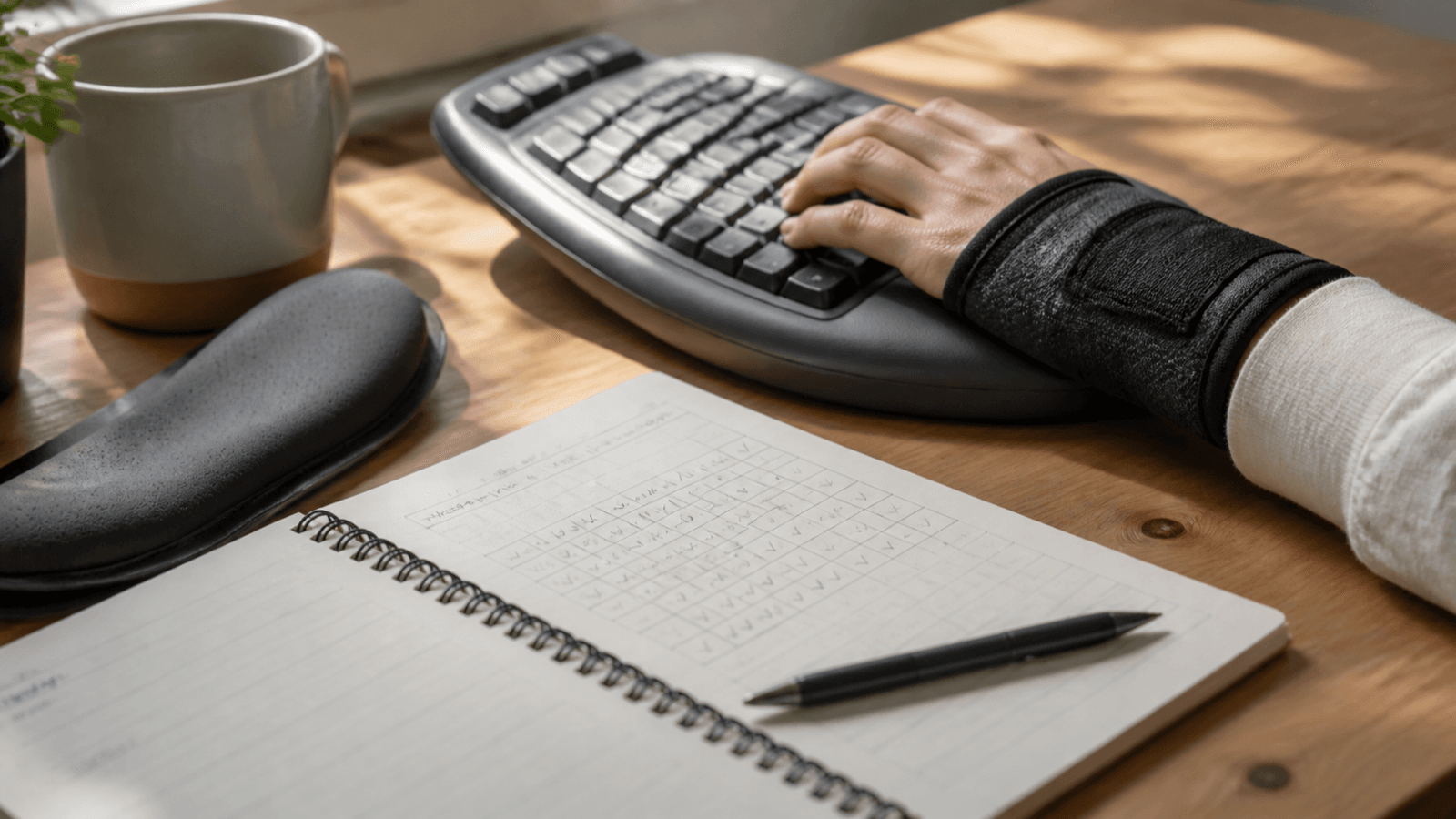
Table of Contents
- What Is Carpal Tunnel Syndrome?
- Evidence for Non-Surgical Treatment
- The Most Effective Conservative Treatments
- Best Wrist Splints and Ergonomic Products
- When Surgery Becomes Necessary
- Ergonomic Changes That Prevent Recurrence
- Frequently Asked Questions
- Sources & Methodology
What Is Carpal Tunnel Syndrome?
Carpal tunnel syndrome (CTS) is compression of the median nerve as it passes through the carpal tunnel — a narrow channel in the wrist bounded by carpal bones on three sides and the transverse carpal ligament on top.
The median nerve provides sensation to the thumb, index finger, middle finger, and half of the ring finger, and motor control to the thenar muscles at the thumb pad. When compressed:
- Sensory symptoms: Tingling, numbness, and burning in the thumb to ring finger (particularly at night and in the morning)
- Motor symptoms: Weakness in pinch grip, dropping objects, difficulty with fine motor tasks
- Pain: Often referred up the forearm or into the shoulder
Severity grades:
- Mild: Intermittent symptoms, no muscle wasting, normal nerve conduction
- Moderate: Persistent symptoms, some sensory deficit, mild nerve conduction changes
- Severe: Constant symptoms, thenar muscle wasting, significant nerve conduction abnormalities
Non-surgical treatment is most appropriate for mild to moderate CTS. Severe CTS typically requires surgical intervention to prevent permanent nerve damage.
Evidence for Non-Surgical Treatment
A 2021 systematic review in the Cochrane Database examined 36 trials of non-surgical CTS treatments and found:
- Corticosteroid injection: Strong evidence for significant short-term improvement (6–12 months in most patients). Does not eliminate the underlying compression but reduces inflammatory swelling.
- Wrist splinting: Moderate-to-strong evidence for symptom reduction in mild CTS, particularly nighttime splinting (reduces compression during sleep when most people flex their wrists).
- Neural mobilisation exercises: Moderate evidence for improved nerve conduction and symptom reduction.
- Activity modification: Essential for lasting outcomes but difficult to study in controlled trials.
The NICE guidance (UK) and American Academy of Orthopaedic Surgeons (AAOS) guidelines both recommend a 3–6 month trial of conservative treatment for mild to moderate CTS before considering surgical referral.
The Most Effective Conservative Treatments
1. Nighttime Wrist Splinting
Evidence level: Strong. First-line treatment for mild CTS.
The carpal tunnel is smallest when the wrist is in full flexion (bent down) — the position many people sleep in unconsciously. Nighttime splinting maintains the wrist in a neutral position, reducing carpal tunnel pressure during the 6–8 hours of sleep.
A splint should hold the wrist at 0–15 degrees of extension (slightly back from neutral). Avoid hyperextension splints, which increase median nerve stretch.
Studies show that nighttime splinting for 6 weeks reduces symptom severity scores by 30–50% in mild CTS. Wearing a splint only at night (not during the day) maintains hand function while addressing the most problematic time for many patients.
2. Corticosteroid Injection
Evidence level: Strong. Most effective short-term non-surgical treatment.
A single corticosteroid injection into the carpal tunnel reduces inflammatory swelling and provides significant symptom relief in most patients. In a 2020 RCT, corticosteroid injection produced superior outcomes to splinting alone at 6-month follow-up.
The effect typically lasts 6–12 months. Repeat injection is possible but is not indefinitely repeatable — most specialists recommend no more than 2–3 injections. If symptoms return despite injection, surgical referral becomes more appropriate.
3. Neural Mobilisation (Nerve Gliding) Exercises
Evidence level: Moderate. Useful adjunct to splinting.
Median nerve gliding exercises move the nerve through its path in the carpal tunnel to prevent adhesions and improve neural mobility. These exercises are performed with specific hand and wrist positions:
- Start position: Fist clenched
- Open fingers straight out
- Extend wrist back
- Open thumb outward
- Stretch thumb away from palm
Hold each position 5–7 seconds. Perform 5–10 repetitions, 2–3 times daily.
4. Ergonomic Modification
Evidence level: Essential for sustained recovery.
No non-surgical treatment produces lasting results without addressing the ergonomic factors that created the compression:
- Keyboard/mouse positioning: Wrist should be neutral, not extended or flexed while typing
- Ergonomic mouse: See our guide on ergonomic mouse for carpal tunnel — vertical mice reduce ulnar deviation and wrist extension
- Break frequency: 5-minute movement break every 30 minutes
- Grip force reduction: Use light touch; gripping too tightly increases flexor tendon pressure in the tunnel
Best Wrist Splints and Ergonomic Products
Mueller Fitted Wrist Brace
Best for: Nighttime splinting, evidence-based
Position: Neutral wrist 0–15 degrees
Check on Amazon →Futuro Night Wrist Sleep Support
Best for: Comfortable all-night wear
Position: Neutral with foam padding
Check on Amazon →Kensington Memory Foam Wrist Rest
Best for: Daytime keyboard ergonomics
Material: Memory foam, neutral wrist position
Check on Amazon →Copper Compression Wrist Brace
Best for: Daytime activity support
Type: Semi-rigid, allows movement
Check on Amazon →Anker Ergonomic Vertical Mouse
Best for: Reducing wrist strain at computer
Design: 57-degree vertical grip
Check on Amazon →When Surgery Becomes Necessary
Surgery (carpal tunnel release) is appropriate when:
1. Symptoms are severe: Constant numbness (not just at night), significant thenar muscle wasting, or loss of two-point discrimination.
2. Conservative treatment has failed: No meaningful improvement after 3–6 months of appropriate splinting + ergonomic changes + at least one corticosteroid injection.
3. EMG shows severe nerve damage: Nerve conduction studies showing severely reduced sensory nerve action potential or absent motor response suggest the nerve needs surgical decompression to recover.
Don't delay if symptoms are severe: Irreversible nerve damage can occur if severe CTS is not treated. Thenar muscle wasting (atrophy of the thumb pad) is a sign that motor nerve function is being lost — this may not fully recover even after surgery if left too long.
Carpal tunnel release surgery is a brief (15–20 minute) procedure with excellent outcomes: 85–90% of patients have complete or near-complete resolution of symptoms. Recovery typically allows return to light work within 2–3 weeks.
Ergonomic Changes That Prevent Recurrence
For more comprehensive ergonomic guidance, see our guides on carpal tunnel exercises, best wrist braces for carpal tunnel, and the full carpal tunnel vs tendinitis comparison.
Frequently Asked Questions
Can carpal tunnel syndrome heal without surgery? Yes, in 50–70% of mild to moderate cases with appropriate conservative treatment. Severe CTS typically requires surgical intervention.
How long does carpal tunnel take to heal without surgery? Mild CTS: significant improvement in 4–8 weeks of consistent splinting and ergonomic changes. Moderate CTS: 3–6 months. Without addressing underlying causes, symptoms return.
What is the best treatment for carpal tunnel without surgery? Nighttime wrist splinting + corticosteroid injection + neural mobilisation exercises + ergonomic modification. Combined approach is more effective than any single treatment.
When should you get surgery? When conservative treatment fails after 3–6 months, when constant numbness is present, when thenar muscle wasting develops, or when EMG shows severe nerve damage.
Sources & Methodology
- Marshall SC et al. (2007). Local corticosteroid injection for carpal tunnel syndrome. Cochrane Database.
- Page MJ et al. (2012). Splinting for carpal tunnel syndrome. Cochrane Database.
- American Academy of Orthopaedic Surgeons. (2016). Management of carpal tunnel syndrome evidence-based clinical practice guideline.
- Padua L et al. (2016). Natural history of carpal tunnel syndrome. Neurological Sciences, 37(5).
- Huisstede BMA et al. (2018). Carpal tunnel syndrome: hand surgeons, hand therapists, and physical medicine and rehabilitation physicians agree on a multidisciplinary treatment guideline. Archives of Physical Medicine and Rehabilitation.
Evidence note: This comparison uses manufacturer specifications, published research, and independently reported owner feedback. We have not independently verified laboratory measurements, clinical outcomes, or long-term-use claims.
Advanced Non-Surgical Options
If standard conservative treatment (splinting + injection) hasn't produced adequate relief, these evidence-based advanced options exist before surgery:
Ultrasound-Guided Injection
Standard corticosteroid injection can be performed "blind" (without imaging guidance) or under ultrasound guidance. Ultrasound-guided injection places the medication more precisely adjacent to the median nerve, reducing injection into the nerve itself and improving effectiveness. Multiple studies show better outcomes with guided versus unguided injection for carpal tunnel.
Platelet-Rich Plasma (PRP)
PRP injection uses concentrated growth factors from your own blood to promote nerve healing. Evidence is preliminary but promising — a 2018 RCT showed PRP produced significantly better outcomes than corticosteroid injection at 3 and 6 months in mild to moderate CTS. It's more expensive and not widely covered by insurance, but growing in use.
Shockwave Therapy (ESWT)
Extracorporeal shockwave therapy delivers mechanical pressure waves to the wrist that stimulate tissue repair. A 2019 systematic review found ESWT produced significant improvements in pain and function for mild to moderate CTS. It is typically 3–5 sessions. Evidence is weaker than for injection but may be preferred for patients who cannot tolerate steroids.
Night Splinting for 6+ Months
The standard 6-week splinting trial may be too short for some patients. Studies show that extending nighttime splinting to 3–6 months produces continued improvement in mild CTS cases that had partial but incomplete response at 6 weeks. Full compliance with neutral-position splinting is essential — most patients sleep with more wrist flexion than they realise, negating the benefit.
Recovery Expectations and Prevention
After Conservative Treatment Resolves Symptoms
Once CTS symptoms have resolved:
- Continue nighttime splinting for 3–6 months after symptom resolution to prevent recurrence
- Maintain ergonomic modifications permanently (the ergonomic factors that caused CTS will cause recurrence if you return to previous habits)
- Stay alert for symptom return — early retreatment is significantly more effective than waiting until symptoms are severe again
Preventing CTS Recurrence
The recurrence rate after conservative treatment without ergonomic change is high (up to 75% within 5 years in repetitive strain occupations). Long-term prevention requires:
Ergonomic stacking:
- Neutral wrist position for all computer work
- Vertical or ergonomic mouse (ergonomic mouse for carpal tunnel)
- Keyboard at appropriate height (no wrist extension while typing)
- Structured breaks every 25–30 minutes
Strength maintenance:
- Thenar (thumb) muscle strengthening exercises
- Intrinsic hand muscle strengthening
- Forearm extensor strengthening (often neglected compared to flexors)
Systemic health factors:
- Blood sugar management (diabetes significantly increases CTS risk and impairs nerve recovery)
- Weight management (obesity is an independent risk factor for CTS)
- Thyroid function check (hypothyroidism causes fluid retention that can compress the carpal tunnel)