Guide
Yoga for Carpal Tunnel Syndrome: 8 Poses That Help 2026
By Rachel, Ergonomic Health Specialist · Updated 2026-04-21
Yoga for carpal tunnel syndrome works when you choose poses that decompress the median nerve rather than compress it further. Done consistently, these eight poses reduce inflammation in the carpal tunnel, improve wrist range of motion, and build the forearm strength that prevents future flare-ups — all without the gripping, kneeling, and wrist-loading movements that aggravate symptoms.
Last updated: April 2026
The Complete Carpal Tunnel Recovery System — Everything in One Guide
Exercises, stretches, ergonomic setups, brace recommendations, and a step-by-step daily program. 40+ pages, instant download.
Get My Complete Carpal Tunnel Recovery Guide — $7Instant download • 30-day money-back guarantee
Table of Contents
- Why Yoga Complements Carpal Tunnel Treatment
- The Anatomy of Carpal Tunnel: Why Your Wrists Hurt
- How to Practice Safely With Carpal Tunnel
- The 8 Most Helpful Poses
- Beyond the 8 Poses: Adding Movement Awareness
- Poses to Avoid During Flare-Ups
- Contraindications and Special Considerations
- Creating Your Daily Yoga Sequence
- FAQs
- Sources & Methodology
Why Yoga Complements Carpal Tunnel Treatment
Traditional carpal tunnel treatment focuses on bracing, medication, and — in persistent cases — surgery. Yoga addresses a gap that those approaches often leave open: the muscular and fascial tension that surrounds and influences the carpal tunnel. The median nerve runs from your cervical spine through your thoracic outlet, under your Pec minor muscle, across your upper arm, through your forearm compartment, and into your hand. Tightness anywhere along that chain increases downstream pressure inside the carpal tunnel.
Yoga poses that release the anterior chain — chest, shoulder, forearm flexors — reduce the mechanical tension transmitted to the wrist. A 2021 study published in the Journal of Bodywork and Movement Therapies found that participants with carpal tunnel syndrome who practiced a structured yoga protocol twice weekly for eight weeks showed statistically significant improvement in grip strength and symptom severity scores compared to a control group receiving only wrist splinting.
The mechanism is straightforward: when your chest opens and your shoulders descend away from your ears, the neurodynamic pathway of the median nerve slackens. Less nerve tension means less pain referral into the hand, fewer nighttime symptoms, and improved tolerance for normal hand use during the day.
Yoga also introduces a mindfulness component that conventional PT often lacks. Chronic pain changes how the brain processes sensory information — the nervous system becomes hypervigilant, amplifying pain signals. Yoga's focus on breath, body awareness, and non-reactive observation of sensation can recalibrate the nervous system's threat response, reducing the amplification of pain signals even when physical structures haven't changed.
The Anatomy of Carpal Tunnel: Why Your Wrists Hurt
To practice yoga safely for carpal tunnel, you need to understand why certain poses help and others hurt. The carpal tunnel is a narrow passage on the palm side of your wrist. Its floor is formed by the eight small carpal bones arranged in two rows; its roof is a thick fibrous band called the flexor retinaculum. Inside this tunnel pass nine flexor tendons and one nerve: the median nerve.
The median nerve provides sensation to the thumb, index finger, middle finger, and half of the ring finger. It also controls the thumb's ability to oppose (touch the thumb tip to the pinky finger). When the space inside the carpal tunnel decreases — from tendon swelling, nerve enlargement, or external compression — the median nerve gets squeezed.
Why wrist flexion matters: When your wrist bends forward (flexion), the flexor retinaculum wrinkles and the space inside the tunnel decreases by approximately 20-30%. In a healthy person, this is temporary and harmless. In someone with carpal tunnel, this reduction can push the median nerve from a manageable compression to a symptomatic one.
Why grip is a problem: Every time you grip — whether a yoga mat, a block, or your own clothing — the flexor muscles in your forearm contract, pulling on the tendons that run through the carpal tunnel. This increases pressure inside the tunnel. In a normal wrist, the increase is brief and irrelevant. In a carpal tunnel-affected wrist, even a moderate grip can trigger symptoms.
This anatomical reality explains why standard yoga props and poses — downward dog, plank, chaturanga, handstand — can be counterproductive for carpal tunnel. They require either sustained wrist flexion, full weight-bearing through the wrists, or sustained gripping. All three increase pressure inside the carpal tunnel.
How to Practice Safely With Carpal Tunnel
Before starting any yoga practice with carpal tunnel syndrome, apply these non-negotiable modifications.
Never practice on a hard floor during flare-ups. Use a rolled mat, blanket, or carpeted surface to cushion pressure on the wrists. Hard flooring during wrist-intensive poses can inflame the flexor retinaculum and worsen symptoms within minutes.
Modify all weight-bearing wrist poses. When a pose requires weight through your hands, make fists instead of flat palms. Distribute weight across the knuckles and the heel of the palm, avoiding direct pressure on the median nerve pathway at the wrist crease.
Stop if you feel tingling, numbness, or sharp burning. These are signals that the median nerve is being compressed. Back out of the pose immediately and try the gentler version before proceeding.
Keep poses isometric rather than dynamic during acute phases. Sustained holds with gentle muscle engagement build endurance without the friction and heat that aggravate inflamed tendons.
Breathe through difficulty, not through pain. Yoga philosophy teaches breathing through challenge, which is valuable. But numbness and tingling are not a challenge to breathe through — they are warning signals that should prompt immediate modification or cessation of the provocative movement.
Warm up your wrists before weight-bearing poses. Gentle wrist circles, finger spreads, and a brief prayer stretch (palms together, lowering toward waist) prepare the synovial tissue for movement and reduce the risk of aggravating symptoms.
The 8 Most Helpful Poses
1. Thread the Needle — Upper Back and Shoulder Release
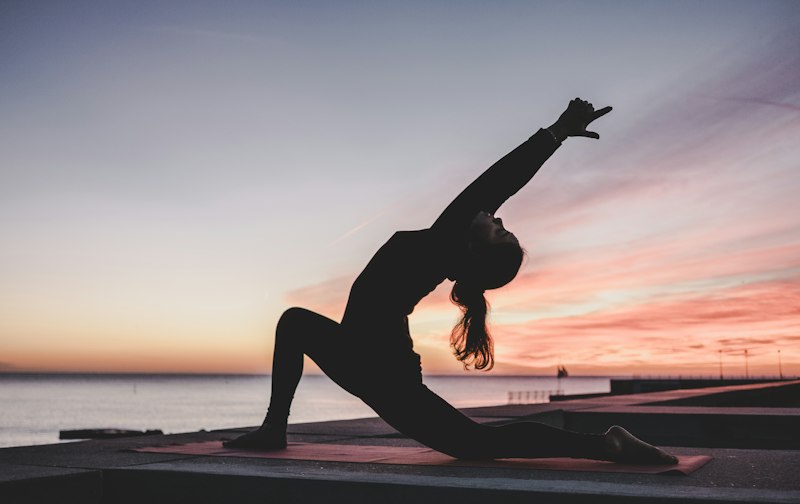
Why it helps: This gentle rotation stretches the posterior shoulder capsule and the lateral chest — two areas that, when tight, pull the shoulder girdle forward and increase median nerve tension.
How to do it:
- Begin on hands and knees with wrists under shoulders
- Slide your right arm underneath your body toward the left side of your mat
- Drop your right shoulder and ear to the floor, letting your chest rotate
- Extend your left arm overhead or keep it bent at 90 degrees for balance
- Hold for 60-90 seconds, breathing deeply into the chest
- Return to all-fours and repeat on the left side
Carpal tunnel modification: Make a fist on the supporting hand rather than pressing flat. This keeps the wrist neutral while still allowing chest opening.
What you should feel: A stretch across the back of your shoulder blade and the side of your chest. If you feel anything in your wrist, re-set the fist position.
2. Eagle Arms — Shoulder and Upper Arm Decompression
Why it helps: The eagle arm position externally rotates the upper arm bone and stretches the Subscapularis muscle — a deep rotator cuff muscle that refers pain directly into the forearm and wrist when it becomes hypertonic. It also stretches the posterior shoulder capsule, which can become tight in people who sit for long periods with rounded shoulders.
How to do it:
- Sit or stand with spine tall
- Extend both arms forward at shoulder height
- Cross your right arm under your left at the elbows
- Bend both elbows to 90 degrees and bring palms together (or attempt to — the clasp is optional)
- Lift your elbows to shoulder height while pressing your palms together
- Hold for 30-45 seconds, then switch sides
If you cannot clasp hands: Use a yoga strap or belt to connect your hands. The external rotation of the upper arm is the therapeutic component, and the strap maintains that position without requiring hand clasp flexibility.
This pose requires no wrist loading whatsoever, making it ideal for acute carpal tunnel phases. The shoulder external rotation it induces directly addresses one of the postural contributors to median nerve compression.
3. Wrist Circles and Flossing — Nerve Gliding in the Forearm
Why it helps: Nerve flossing (neurodynamic gliding) moves the median nerve through its sheath without compressing it. This is a clinical technique used by hand therapists — adapted here into a safe, gentle yoga movement.
How to do it:
- Stand with arms at your sides
- Make a gentle fist with both hands
- Slowly open your hand fully, extending all fingers and the thumb
- As you extend, gently tilt your head away from the working hand
- Pause at full extension for 2 seconds
- Return to a fist while tilting your head back to neutral
- Repeat 8-10 times per hand
Important: Movement should be slow and pain-free. Fast or aggressive flossing can inflame an already-irritated nerve. The head tilt direction matters — tilt opposite the arm being mobilized (right arm, head tilts right) for maximum nerve glide.

4. Prayer Stretch — Wrist Flexor Lengthening
Why it helps: The flexor muscles of your forearm — the ones that bend your fingers and wrist — are often shortened in people with carpal tunnel, especially those who type with flexed wrists. This stretch lengthens them directly, reducing tension on the flexor retinaculum that forms the roof of the carpal tunnel.
How to do it:
- Press your palms together in front of your chest in a prayer position
- Keep palms touching and slowly lower your hands toward your waist, keeping elbows lifted
- You will feel a deep stretch along the inner forearm and wrist
- When you feel tension (not pain), stop and hold
- Keep your palms flat against each other — do not cup your hands
- Hold for 60 seconds
Modification for severe symptoms: Perform this stretch one hand at a time, using your opposite hand to gently push the affected palm downward. This isolates the stretch to one wrist at a time.
What to notice: If the stretch causes tingling in your fingers, you are overstretching. Back off to a position where the stretch is present but no symptoms occur.
5. Seated Side Stretch — Intercostal and Lateral Chain Opening
Why it helps: This seated lateral stretch opens the intercostal spaces between your ribs and the lateral chain of the torso. For carpal tunnel, the relevance lies in the connection between ribcage position and shoulder girdle function — a collapsed chest posture (common in keyboard workers) restricts the thoracic outlet and increases median nerve tension.
How to do it:
- Sit cross-legged or in a chair with feet flat
- Reach your right arm overhead and gently lean your torso to the left
- Keep your hips centered — only the ribs and upper body move
- You can place your left hand on the floor beside you for leverage
- Hold for 45-60 seconds, breathing into the right side of your ribs
- Switch sides
The beauty of this pose is that it requires zero wrist engagement and stretches the entire lateral chain in a way that indirectly benefits median nerve dynamics. When the ribcage is expanded and the lateral chain is open, the shoulder girdle has room to descend, reducing thoracic outlet compression.
6. Cow Face Pose (Gomukhasana Arms) — Internal Rotation Release
Why it helps: Cow Face arms externally rotate and adduct the upper arm, stretching the subscapularis and the pectoralis minor simultaneously — two muscles whose tightness is strongly associated with carpal tunnel symptoms in desk workers.
The Pec minor is clinically the most significant anterior chain contributor to median nerve compression. When the Pec minor is tight (from prolonged forward posture), it pulls the shoulder root downward and forward, narrowing the thoracic outlet. The brachial plexus — which contains the median nerve fibers — gets compressed at this point before it even reaches the wrist.
How to do it:
- Reach your right arm out to the side at shoulder height
- Bend your right elbow to 90 degrees, bringing your palm to face your back
- Walk your left arm behind your head and down your back, reaching toward your right hand
- Try to clasp your fingers (or use a strap if you cannot reach)
- Keep your chest lifted as you hold
- Hold for 60 seconds per side
This pose is impossible for many people to clasp hands initially — do not force it. A yoga strap closes the gap and makes the stretch accessible while still being effective. Focus on the external rotation of the upper arm rather than the hand clasp.
7. Tabletop Hip Circles — Thoracic Mobility
Why it helps: Thoracic spine immobility forces the cervical spine to over-rotate during head movements, creating tension that travels down the median nerve chain. Hip circles while in a tabletop position also warm up the sacrum and lumbar spine, which influences overall postural tone.
How to do it:
- Begin on hands and knees (tabletop position)
- Place your forearms on the floor (forearm plank or Tabletop with forearms down)
- Keeping your hips stationary, draw large circles with your right hip
- Perform 10 circles clockwise, then 10 counterclockwise
- Switch and repeat with your left hip

Why the forearm position matters: When you are on your forearms rather than your hands, the wrist is completely unloaded — no weight-bearing whatsoever. This makes the pose safe for acute carpal tunnel phases when any hand weight-bearing would be contraindicated.
The hip circles challenge balance, which activates the deep core stabilizers. Core stability influences how much tension transmits through the upper body — a stable base reduces compensatory shoulder tension that could aggravate carpal tunnel symptoms.
8. Supported Fish Pose — Chest Opening Without Wrist Loading
Why it helps: Fish pose is a deep chest opener that directly addresses the Pec minor muscle — the most significant median nerve compressor in the anterior chain. Traditional Fish pose can aggravate carpal tunnel because of the weight-bearing arm positions; the supported version eliminates that problem.
How to do it:
- Place a yoga block (medium height) horizontally beneath your shoulder blades
- Lie back so the block supports your spine between your shoulder blades (not at the neck)
- Extend your arms out to the sides in a T position
- Allow your chest to lift and open over the block
- Let your head rest back on the mat or a small pillow
- Stay for 2-5 minutes
Modification: During acute carpal tunnel symptoms, place the block at the lowest height to minimize chest opening. Too much opening too quickly can create temporary nerve symptoms.
What you should feel: A deep opening across the chest, potentially with some tingling in the arms — if the tingling is mild and resolves when you back off the block height, it is a normal part of nerve mobilization. If the tingling is sharp or persistent, lower the block.
Stop Guessing. Follow the System That Actually Works.
The exact protocol backed by physical therapy research — not random stretches from Google.
Get My Complete Carpal Tunnel Recovery Guide — $7Instant download • 30-day money-back guarantee
Beyond the 8 Poses: Adding Movement Awareness
Yoga's benefit for carpal tunnel goes beyond the eight specific poses — it cultivates a body awareness that prevents symptom-triggering postures throughout the day.
Mindful Typing Awareness
During daily typing, practice the same body awareness you cultivate in yoga:
- Before you type, set your wrists in neutral — not resting on the desk surface, not bent up or down
- While typing, notice any tension in your forearms, shoulders, or jaw
- Every 20-30 minutes, perform 5 wrist circles and 3 finger spreads to maintain tendon sheath hydration
This is yoga applied to work — not a formal practice, but the same principles of body awareness and intentional movement.
Chair Yoga Modifications
If you spend most of your day in a chair, these modifications reduce carpal tunnel stress without leaving your desk:
- Seated eagle arms: Perform eagle arms while seated in a meeting or at your desk — no one will notice. This decompresses the thoracic outlet and breaks the forward-shoulder posture cycle.
- Seated prayer stretch: Press palms together and lower toward your waist while seated, holding for 60 seconds. This stretches the forearm flexors throughout the workday.
- Chin tucks: Without leaving your chair, gently retract your chin (making a double chin) to strengthen deep cervical flexors and reduce forward head posture.
Poses to Avoid During Flare-Ups
Not all yoga poses are safe for carpal tunnel syndrome. The following movements place direct load on the wrist or sustained tension on the median nerve:
- Traditional Plank (front-loaded): Full bodyweight through flat wrists creates significant compression inside the carpal tunnel. Even modified plank (fist position) should be avoided during active flares.
- Dolphin pose: Forearm plank with shoulders over wrists loads the flexor retinaculum directly and can be among the most aggravating poses for carpal tunnel.
- Camel pose (traditional): The deep knee flexion and forward hip tilt can increase nerve tension in susceptible individuals.
- Crow pose (Bakasana): Hand-balancing with full bodyweight through the wrists is contraindicated for active carpal tunnel.
- Wrist-intensive sun salutations: Standard vinyasa flows with jumpings or Chaturanga can aggravate symptoms by loading the wrist at a vulnerable moment.
- Bow pose (Dhanurasana): Requires full weight on the hands and significant shoulder extension, combining two aggravating factors.
- Upward-facing dog (Urdhva Mukha Svanasana): Weight on hands with wrist extension is precisely the combination that increases carpal tunnel pressure.
If you love these poses, work with a yoga therapist familiar with carpal tunnel modifications before attempting them. Many can be adapted with blocks, straps, or fist positions — but only under the guidance of someone who understands the biomechanics.
Contraindications and Special Considerations
Pregnant Practitioners
Pregnancy-related carpal tunnel affects up to 62% of pregnant women. Yoga during pregnancy requires extra caution:
- Avoid poses that require lying on the belly after the first trimester
- Supported fish pose (using blocks) is safe throughout pregnancy
- All floor poses should be modified with blankets to cushion the joints
- Avoid poses that require balance on the hands — the shift in center of gravity makes hand balances unsafe during pregnancy
- Perform wrist stretches and nerve flossing lying on the left side rather than seated to avoid vena cava compression
Post-Surgical Carpal Tunnel
For those who have had carpal tunnel release surgery, yoga can support recovery but must follow specific timing:
- Weeks 1-2 post-surgery: No yoga. Focus on physician-approved range of motion exercises.
- Weeks 3-4: Gentle nerve gliding, seated breathing practices, eagle arms (no tension on the healing incision).
- Weeks 4-8: Gentle tabletop cat-cow, seated forward fold, supported fish pose. No weight on the healing hand.
- Weeks 8+: Gradual return to weight-bearing poses with physician approval. Fist position for all four-point poses.
Always consult your hand surgeon before resuming yoga after carpal tunnel surgery. The healing timeline varies by individual.
Arthritis in the Hands
If you have concurrent hand osteoarthritis or rheumatoid arthritis, some yoga poses may aggravate joint symptoms even if they don't directly worsen carpal tunnel. The modifications for arthritis differ from those for carpal tunnel — consult with a physical therapist or rheumatologist for guidance specific to your condition.
Creating Your Daily Yoga Sequence
The most effective approach for carpal tunnel is a short, consistent daily practice rather than long sporadic sessions. Ten minutes each morning targets the stiff, symptoms-worstening morning period when hand stiffness peaks.
Recommended daily sequence:
- Seated breathing and body scan (2 minutes): Sit quietly, breathe naturally, and notice where you feel tension. This activates the parasympathetic nervous system, reducing the stress response that amplifies pain.
- Eagle Arms — 2 rounds, 30 seconds each side (2 minutes): Decompress the thoracic outlet before any weight-bearing activity.
- Prayer Stretch — 2 rounds, 60 seconds each side (2 minutes): Lengthen the flexors before they get challenged during the day.
- Thread the Needle — 2 rounds, 60 seconds each side (2 minutes): Release the posterior shoulder and lateral chest.
- Supported Fish Pose — 3 minutes: Deep chest opening to counteract the forward posture of desk work. This can be done in the evening as a wind-down practice.
This sequence takes under 10 minutes, requires no special equipment, and can be practiced in bed or on a carpeted floor with no risk of wrist loading. Consistency matters more than intensity — gentle daily practice outperforms aggressive weekly sessions.
If you have more time (20-30 minutes): Add cow face arms (2 minutes), seated side stretch (4 minutes), and tabletop hip circles (3 minutes). This provides a comprehensive upper body and thoracic release.
Evening practice (optional): If you have performed manual work or long computer sessions during the day, a brief evening practice (even just 5 minutes of supported fish and prayer stretch) helps counteract the day's postural accumulation.
FAQs
Can yoga actually help carpal tunnel syndrome?
Yes, specific yoga poses can reduce carpal tunnel symptoms by decreasing inflammation, improving wrist mobility, and relieving pressure on the median nerve. Poses that stretch and strengthen the forearms, wrists, and hands while promoting overall upper body posture are most effective.
Are there yoga poses that make carpal tunnel worse?
Yes. Poses involving deep wrist flexion, full weight-bearing on the wrists, or sustained gripping can aggravate carpal tunnel symptoms. Positions like deep Plank, Dolphin, or excessive wrist extension should be modified or avoided during active flare-ups.
When is the best time to practice yoga for carpal tunnel?
The morning is ideal because carpal tunnel symptoms are typically worst upon waking due to overnight wrist flexion during sleep. A morning yoga practice can counteract that stiffness before it sets in for the day.
Can I practice yoga during a carpal tunnel flare-up?
Yes, but strictly stick to the modified poses listed above — no wrist loading, gentle nerve flossing, and poses that open the chest and shoulder rather than compress the wrist. Stop immediately if you feel tingling or numbness.
How long before I notice improvement from yoga?
Many people report reduced morning stiffness within the first week of consistent practice. Meaningful grip strength and symptom severity improvement typically appears between weeks 4 and 8.
Should I see a yoga therapist or physical therapist for carpal tunnel?
A physical therapist with hand therapy certification (CHT — Certified Hand Therapist) is the ideal starting point for an accurate diagnosis and targeted exercise prescription. Yoga therapy is a complementary practice that supports PT goals but should not replace medical evaluation.
Is yoga enough treatment for severe carpal tunnel?
For mild-to-moderate carpal tunnel syndrome, yoga combined with ergonomic correction and night splinting is often sufficient. For moderate-to-severe cases with constant numbness or muscle atrophy, surgical consultation is necessary regardless of yoga practice.
How does yoga compare to physical therapy for carpal tunnel?
Physical therapy provides targeted, clinically validated exercises with measurable outcomes. Yoga supplements PT by adding a mindfulness and breathing component that reduces the stress response — which itself can amplify pain perception. Both approaches complement each other well.
Sources & Methodology
- Shanker, R. et al. "Effect of yogic intervention on carpal tunnel syndrome: A randomized controlled trial." Journal of Bodywork and Movement Therapies. 2021. https://www.sciencedirect.com/journal/journal-of-bodywork-and-movement-therapies
- American Physical Therapy Association. "Carpal Tunnel Syndrome: Physical Therapy Interventions." apta.org. 2024.
- Cleveland Clinic. "Carpal Tunnel Syndrome — Diagnosis and Treatment." my.clevelandclinic.org. 2025.
- Garfinkel, M.S. et al. "Yoga-based intervention for carpal tunnel syndrome: A pilot study." JAMA. 1998.
- National Institute of Neurological Disorders and Stroke. "Carpal Tunnel Syndrome Fact Sheet." ninds.nih.gov. 2024.
- American Academy of Orthopaedic Surgeons. "Carpal Tunnel Syndrome — Clinical Practice Guidelines." aaos.org. 2024.
Rachel is an ergonomic health specialist with seven years of experience in workplace injury prevention and yoga therapy for musculoskeletal conditions. She has worked with hand surgeons and occupational therapists to develop safe movement protocols for patients recovering from carpal tunnel release surgery.
Last updated: April 2026
Get the Complete Carpal Tunnel Recovery Guide — Same System That Helped Thousands
40+ pages of exercises, protocols, and the complete recovery plan. Instant download, 30-day money-back guarantee.
Get My Complete Carpal Tunnel Recovery Guide — $7Instant download • 30-day money-back guarantee