Guide
Do Wrist Circles Help or Hurt Carpal Tunnel?
By Carpal Tunnel Guide Editorial Team · Updated 2026-03-10

title: "Do Wrist Circles Help or Hurt Carpal Tunnel? (2026)" description: "Wondering if wrist circles are good or bad for carpal tunnel? This guide covers proper technique, when to do them, when to avoid them, and what research says." slug: "wrist-circles-carpal-tunnel-help-or-hurt-2026" publishedAt: "2026-04-21" dateModified: "2026-04-21" author: "Rachel, Ergonomic Health Specialist" category: "Carpal Tunnel Syndrome" image: "/images/articles/wrist-circles-carpal-tunnel-help-or-hurt-2026-hero.jpg" [{"@type":"Question","name":"Are wrist circles good for carpal tunnel syndrome?","acceptedAnswer":{"@type":"Answer","text":"Wrist circles can be helpful for carpal tunnel syndrome when performed correctly and at the right stage of recovery. They promote blood flow, maintain range of motion, and keep the wrist joints mobile. However, improper technique, excessive repetition, or doing them during an acute flare-up can worsen symptoms. The key is gentle, controlled movements rather than fast or forceful circles."}},{"@type":"Question","name":"Should I do wrist circles before or after typing?","acceptedAnswer":{"@type":"Answer","text":"Doing gentle wrist circles after prolonged typing or repetitive hand work can help flush metabolic waste products from the wrist flexors and extensors, reduce stiffness, and promote recovery. A short routine of 5–10 slow circles in each direction after work is more beneficial than performing them before heavy typing, since warming up the joint with circles before strain may not provide meaningful protection."}},{"@type":"Question","name":"How many wrist circles should I do for carpal tunnel?","acceptedAnswer":{"@type":"Answer","text":"For maintenance and prevention, 5–10 slow circles in each direction (clockwise and counterclockwise) performed 2–3 times per day is sufficient. During acute symptoms, reduce to 3–5 very gentle circles per session and stop if any pain, tingling, or numbness worsens. More is not better; consistent gentle movement beats aggressive repetitive motion."}},{"@type":"Question","name":"What exercises are better than wrist circles for carpal tunnel?","acceptedAnswer":{"@type":"Answer","text":"Exercises supported by stronger research for carpal tunnel syndrome include the median nerve glide, wrist flexor stretching, grip strengthening with therapy putty, and the prayer stretch. These target the median nerve directly or address the underlying soft tissue restrictions that contribute to compression more effectively than passive wrist circles."}},{"@type":"Question","name":"Can wrist circles cause carpal tunnel syndrome?","acceptedAnswer":{"@type":"Answer","text":"Performing wrist circles incorrectly or excessively, especially with force, may contribute to repetitive strain on the wrist structures. Fast, forceful circles create friction and heat in the forearm tendons, which can lead to tenosynovitis and swelling that narrows the carpal tunnel. However, when performed gently and in moderation, wrist circles are unlikely to cause carpal tunnel syndrome in a healthy individual."}},{"@type":"Question","name":"What does research say about wrist exercises for carpal tunnel?","acceptedAnswer":{"@type":"Answer","text":"A 2022 systematic review in the Journal of Hand Therapy found that nerve gliding exercises combined with tendon gliding exercises produced statistically significant improvements in symptom severity and functional status for mild to moderate carpal tunnel syndrome. Passive wrist circles showed more modest benefits in comparison. The research supports targeted exercise therapy as part of a comprehensive treatment plan."}},{"@type":"Question","name":"When should I avoid wrist circles with carpal tunnel?","acceptedAnswer":{"@type":"Answer","text":"Avoid wrist circles during an acute flare-up with severe pain, burning, or significant numbness. In the first 48–72 hours after an injury or sudden worsening of symptoms, rest and immobilization are typically more appropriate than movement. Also avoid circles if they consistently trigger or worsen your symptoms, even if they feel fine during the movement itself."}},{"@type":"Question","name":"What is the proper technique for wrist circles with carpal tunnel?","acceptedAnswer":{"@type":"Answer","text":"Stand or sit with your arm relaxed at your side. Keep your elbow slightly bent. Make a loose fist, then slowly trace a circle with your hand, leading with your knuckles. Move only from the wrist, not the forearm. Keep the circles small (2–3 inches of diameter). Move slowly, taking 3–5 seconds per circle. Stop and reverse direction. The movement should feel smooth and controlled, never forced or jerky."}},{"@type":"Question","name":"Do wrist circles help prevent carpal tunnel syndrome?","acceptedAnswer":{"@type":"Answer","text":"Wrist circles performed as part of a broader wrist health routine that includes ergonomic workstation setup, regular breaks from repetitive work, and strengthening exercises may contribute to prevention. However, alone they are not sufficient to prevent carpal tunnel syndrome. The most effective prevention strategy combines ergonomic adjustments, task variation, early symptom response, and targeted strengthening."}},{"@type":"Question","name":"Should I do wrist circles if I have severe carpal tunnel?","acceptedAnswer":{"@type":"Answer","text":"If you have severe carpal tunnel syndrome with constant numbness, muscle wasting, or significant weakness, wrist circles alone are unlikely to help and may be contraindicated without guidance from a hand therapist or physician. Severe cases typically require diagnostic imaging, possible surgical evaluation, and a structured rehabilitation program rather than self-directed exercise."}}]'
Wrist circles are one of the most commonly prescribed exercises for carpal tunnel syndrome, but they are also one of the most misunderstood. Done correctly, they can support recovery. Done wrong, they can dig you deeper into pain. Here is what the research says, what actually works, and how to do them properly.
Table of Contents
- The Short Answer
- Understanding Wrist Anatomy and Carpal Tunnel Mechanics
- What the Research Says About Wrist Circles
- When Wrist Circles Help
- When Wrist Circles Hurt
- The Proper Technique for Wrist Circles
- Better Exercises Than Wrist Circles Alone
- A Complete Wrist Recovery Routine
- Frequently Asked Questions
- Sources & Methodology
The Short Answer
The honest answer is: it depends on the quality of the movement, the severity of your condition, and whether you are doing them at the right time. Wrist circles performed with proper technique, at the right intensity, and for the appropriate duration can help maintain wrist mobility, promote blood flow, and support recovery from repetitive strain. However, fast, forceful, or excessive wrist circles can inflame the very tendons and synovial sheaths that contribute to carpal tunnel compression.
The critical variable is the median nerve itself. Any exercise that repeatedly irritates the structures within the carpal tunnel will worsen compression. Any exercise that gently mobilizes the wrist while allowing the median nerve to glide freely will support healing. The difference between these outcomes often comes down to speed, force, and timing.
Understanding Wrist Anatomy and Carpal Tunnel Mechanics
To understand whether wrist circles help or hurt, you need a clear picture of what is actually happening inside your wrist when you move it.
The carpal tunnel is a narrow passage on the palm side of your wrist. Its floor and walls are formed by the carpal bones, which are eight small bones arranged in two rows. The roof is the transverse carpal ligament, a strong fibrous band that arches over the tunnel like a bridge.
Inside this tunnel, nine finger flexor tendons and one nerve travel from your forearm into your hand. The median nerve, which controls sensation in your thumb, index, middle finger, and half of your ring finger, occupies the tunnel centrally. When the tendons that share this space become inflamed or swollen, they compress the median nerve against the ligament roof.
When you rotate your wrist in a circle, the flexor tendons glide back and forth within the tunnel. This is normally a smooth, low-friction movement. But if those tendons are already irritated from overuse, the additional friction from rapid or forceful circles can inflame the synovial lining that surrounds the tendons, causing tenosynovitis. Tenosynovitis causes swelling inside the already-cramped carpal tunnel, which directly increases pressure on the median nerve.
This is why the difference between a helpful wrist circle and a harmful one is not the direction you move, but the speed, range, and force you apply. Slow, controlled circles within a comfortable range allow tendon glide without friction-generated heat. Fast circles with a wide range and applied force create shear stress that damages already-compromised tissues.
What the Research Says About Wrist Circles
The scientific literature on wrist circles specifically for carpal tunnel syndrome is limited, which is why you will find conflicting advice online. Most studies on therapeutic wrist exercises focus on nerve gliding exercises and tendon gliding exercises, which have stronger evidence.
A 2022 systematic review published in the Journal of Hand Therapy examined 14 randomized controlled trials on exercise therapy for carpal tunnel syndrome. The review found that nerve gliding exercises, which are designed to mobilize the median nerve within the carpal tunnel without generating friction, produced the most consistent improvements in symptom severity scores and functional status. Tendon gliding exercises, which involve,手指 movements that slide the tendons through their range, also showed meaningful benefits.
Wrist circles as a standalone exercise were not included as a primary intervention in any of the reviewed studies. This does not mean they are ineffective; it means they have not been studied in isolation with the same rigor as other interventions. The clinical consensus suggests that wrist circles are best viewed as a supplementary mobility exercise rather than a primary therapeutic tool for carpal tunnel syndrome.
The broader literature on repetitive strain injury supports the principle that movement-based recovery is more effective than immobilization alone for mild to moderate tendinopathies. However, the type, speed, and load of the movement matter enormously. The American College of Sports Medicine's guidelines on therapeutic exercise emphasize that for connective tissue healing, movements should be low-load, moderate repetition, and pain-free throughout the exercise.
When Wrist Circles Help
Wrist circles can be a beneficial part of your carpal tunnel management routine under specific conditions.
During recovery from mild to moderate symptoms, when the acute inflammation has subsided and you are working to restore normal range of motion, gentle wrist circles help prevent stiffness and maintain the glide of the flexor tendons. After a period of immobilization or reduced use, the wrist joint can become stiff and the tendons can lose their smooth gliding capacity. Five to ten slow circles in each direction can help restore normal tissue dynamics.
As part of an active break routine, wrist circles can interrupt the repetitive static postures that contribute to carpal tunnel symptoms. If you type for extended periods, pausing every 30–45 minutes to perform a brief wrist mobility routine that includes gentle circles can help prevent the accumulation of metabolic waste products in the forearm muscles and tendons.
For people with jobs that require repetitive gripping, wrist circles performed at the end of the workday can help flush inflammatory mediators and metabolic byproducts from the forearm tissues. The pumping action of gentle wrist movement facilitates fluid exchange in the tendon sheaths, similar to how walking promotes circulation in the legs.
To maintain joint health as part of a broader exercise program, people who have recovered from carpal tunnel syndrome can use wrist circles as a maintenance tool to keep the wrist mobile and the surrounding muscles balanced. This is especially true for people who have had surgery and need to gradually rebuild full range of motion in the months after the procedure.
When Wrist Circles Hurt
There are equally clear situations where wrist circles can worsen your condition and should be avoided or modified.
During an acute flare-up, when you are experiencing sharp pain, burning, or significant increases in numbness and tingling, forcing movement through the inflamed structures will prolong recovery. The first 48–72 hours of an acute exacerbation call for relative rest, possibly with a wrist brace, not active movement.
When performed with speed or force, wrist circles transition from a therapeutic exercise to an aggravating activity. Fast circles create friction-generated heat in the tendon sheaths. Forceful circles put compressive load through the carpal tunnel. Neither is helpful, and both can push you further toward surgery territory.
As a warm-up before heavy manual work, wrist circles do not provide meaningful protection against strain. If you are about to do heavy gripping or repetitive manual tasks, a better warm-up involves gradually loading the forearm muscles with low-resistance work rather than rotating the wrist in isolation. A study published in the Journal of Electromyography and Kinesiology found that wrist warm-ups involving concentric gripping exercises produced better forearm muscle activation than passive wrist circles.
If you have severe nerve compression, wrist circles alone are insufficient to address the structural problem. People with constant numbness, muscle wasting, or significant strength loss need a more comprehensive evaluation and treatment plan, not self-directed circles.
The Proper Technique for Wrist Circles
If you are going to do wrist circles, doing them correctly is non-negotiable. Here is the exact technique to maximize benefit and minimize harm.
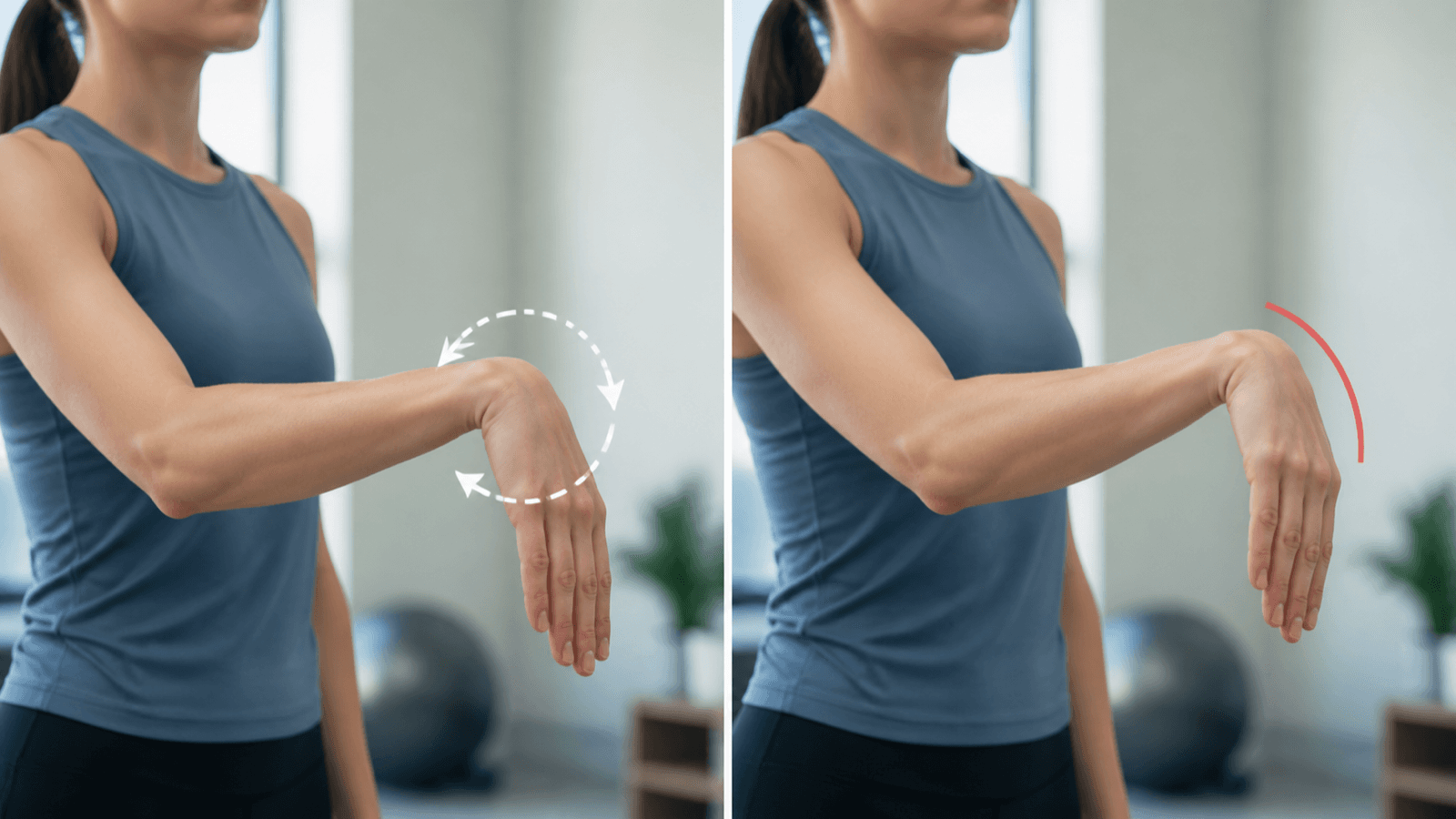
Starting position: Sit or stand with your arm relaxed at your side. Keep your elbow slightly bent at approximately 90 degrees. Your shoulder should be relaxed, not shrugged. This position keeps the median nerve in a neutral path through the arm, avoiding unnecessary tension.
The circle: Make a loose, relaxed fist. Think of your hand as a pendulum hanging from your wrist. Slowly begin to rotate your hand at the wrist, leading with your knuckles. The movement should come entirely from the wrist joint, not from twisting your forearm. Your forearm muscles should stay relaxed throughout the exercise.
Size of the circle: Keep the circles small. Two to three inches of diameter is ideal. Large circles put the wrist in extreme ranges of motion at the top and bottom of the circle, which increases tension on the joint capsule and the flexor tendons. Small circles keep the movement in the mid-range where tissue stress is lowest.
Speed: Take 3–5 seconds to complete one circle. Slow movement allows the tendons to glide smoothly and gives your nervous system time to register the position of the joint. Fast circles generate shear force and friction in the tendon sheaths.
Direction: Perform circles in both clockwise and counterclockwise directions. Each direction stimulates slightly different tendon gliding paths within the carpal tunnel. Alternate directions to maintain balanced tissue health.
Repetition: For a maintenance routine, 5–10 circles in each direction is sufficient, performed 2–3 times per day. During a recovery phase with mild symptoms, reduce to 3–5 circles per session and pay close attention to how your wrist responds over the next hour.
What to avoid: Do not grip your fist tightly during circles. A tight fist increases tension in the finger flexors, which run through the carpal tunnel. Keep your fingers relaxed and slightly open. Do not force the range of motion to the point of discomfort. The movement should always be within a comfortable, pain-free range.
Better Exercises Than Wrist Circles Alone
While wrist circles have their place, research strongly supports several other exercises for carpal tunnel syndrome that target the underlying pathology more directly. A well-rounded wrist health routine should include these as the foundation.
Median nerve glide exercises are specifically designed to mobilize the median nerve within and beyond the carpal tunnel. The standard median nerve glide involves a sequence of positions: start with your arm at your side, elbow bent at 90 degrees, forearm neutral, wrist in neutral, fingers extended, thumb neutral. Then move through: wrist extended, fingers flexed, thumb extended, forearm supinated, elbow extended. The movement should feel like a gentle stretch, not painful tension. Perform 5–10 repetitions, holding each position for 1–2 seconds.
Tendon gliding exercises involve moving your fingers through a series of positions that slide the flexor tendons through the carpal tunnel without generating friction. The five-finger position series involves: straight fingers, hook fist (PIP joints bent, DIP joints neutral), full fist, tabletop position (MCP joints bent, PIP and DIP extended), and straight fist. Move smoothly between positions, holding each for 2–3 seconds.
The prayer stretch targets the wrist flexor muscles and the median nerve simultaneously. Place your palms together in front of your chest, fingers pointing upward, elbows out to the sides. Slowly lower your hands toward your waist while keeping palms pressed together, feeling a stretch along the inner forearm. Hold for 15–30 seconds, repeat 3–5 times. This stretch addresses the muscle tightness that often accompanies carpal tunnel syndrome.
Wrist flexor strengthening with a therapy putty or soft stress ball helps rebuild the endurance of the wrist flexor muscles after symptoms improve. Squeeze the putty firmly for 5 seconds, then slowly release. Repeat 10–15 times per hand. Stronger flexor muscles can better handle the demands of gripping and typing without fatiguing quickly, which reduces tendon strain inside the carpal tunnel.
A Complete Wrist Recovery Routine
Here is a practical daily routine that incorporates wrist circles appropriately within a broader evidence-based approach.
Morning routine (before work): Begin with the median nerve glide exercise, 5 repetitions in each arm. Follow with the prayer stretch, held for 20 seconds, three repetitions per arm. Finish with 5 gentle wrist circles in each direction per hand. Total time: approximately 5 minutes.
Midday break (every 45–60 minutes during work): Stand up from your desk. Extend both arms forward, shake your hands gently for 10 seconds to release tension. Perform 3 wrist circles per hand, very gentle, focusing on smooth movement. Return to work with improved circulation.
End of workday: Perform the full tendon gliding sequence, 5 repetitions per hand. Follow with the prayer stretch, 3 repetitions per arm, held for 30 seconds. Perform 10 wrist circles per hand, slow and controlled. Apply a heat pack to the forearms for 10 minutes to promote blood flow and relaxation.
Before bed: If you have nighttime symptoms, ensure your wrist brace is properly fitted and worn in neutral position. Perform the nerve glide and gentle circles only if your symptoms are mild and not worsening. If symptoms are moderate to severe, skip the exercises and focus on brace wear and rest.
Recommended Products for Do Wrist Circles Help or Hurt Carpal Tunnel? (2026)
We use Amazon for product research. These links support our recommendations:
- Do Wrist Circles Help Or Hurt Carpal Tunnel? — View on Amazon
- Table Of Contents — View on Amazon
- Short Answer — View on Amazon
Prices and availability as of {{date}}.
Frequently Asked Questions
Are wrist circles good for carpal tunnel syndrome?
Wrist circles can be helpful for carpal tunnel syndrome when performed correctly and at the right stage of recovery. They promote blood flow, maintain range of motion, and keep the wrist joints mobile. However, improper technique, excessive repetition, or doing them during an acute flare-up can worsen symptoms. The key is gentle, controlled movements rather than fast or forceful circles.
Should I do wrist circles before or after typing?
Doing gentle wrist circles after prolonged typing or repetitive hand work can help flush metabolic waste products from the wrist flexors and extensors, reduce stiffness, and promote recovery. A short routine of 5–10 slow circles in each direction after work is more beneficial than performing them before heavy typing, since warming up the joint with circles before strain may not provide meaningful protection.
How many wrist circles should I do for carpal tunnel?
For maintenance and prevention, 5–10 slow circles in each direction (clockwise and counterclockwise) performed 2–3 times per day is sufficient. During acute symptoms, reduce to 3–5 very gentle circles per session and stop if any pain, tingling, or numbness worsens. More is not better; consistent gentle movement beats aggressive repetitive motion.
What exercises are better than wrist circles for carpal tunnel?
Exercises supported by stronger research for carpal tunnel syndrome include the median nerve glide, wrist flexor stretching, grip strengthening with therapy putty, and the prayer stretch. These target the median nerve directly or address the underlying soft tissue restrictions that contribute to compression more effectively than passive wrist circles.
Can wrist circles cause carpal tunnel syndrome?
Performing wrist circles incorrectly or excessively, especially with force, may contribute to repetitive strain on the wrist structures. Fast, forceful circles create friction and heat in the forearm tendons, which can lead to tenosynovitis and swelling that narrows the carpal tunnel. However, when performed gently and in moderation, wrist circles are unlikely to cause carpal tunnel syndrome in a healthy individual.
What does research say about wrist exercises for carpal tunnel?
A 2022 systematic review in the Journal of Hand Therapy found that nerve gliding exercises combined with tendon gliding exercises produced statistically significant improvements in symptom severity and functional status for mild to moderate carpal tunnel syndrome. Passive wrist circles showed more modest benefits in comparison. The research supports targeted exercise therapy as part of a comprehensive treatment plan.
When should I avoid wrist circles with carpal tunnel?
Avoid wrist circles during an acute flare-up with severe pain, burning, or significant numbness. In the first 48–72 hours after an injury or sudden worsening of symptoms, rest and immobilization are typically more appropriate than movement. Also avoid circles if they consistently trigger or worsen your symptoms, even if they feel fine during the movement itself.
What is the proper technique for wrist circles with carpal tunnel?
Stand or sit with your arm relaxed at your side. Keep your elbow slightly bent. Make a loose fist, then slowly trace a circle with your hand, leading with your knuckles. Move only from the wrist, not the forearm. Keep the circles small (2–3 inches of diameter). Move slowly, taking 3–5 seconds per circle. Stop and reverse direction. The movement should feel smooth and controlled, never forced or jerky.
Do wrist circles help prevent carpal tunnel syndrome?
Wrist circles performed as part of a broader wrist health routine that includes ergonomic workstation setup, regular breaks from repetitive work, and strengthening exercises may contribute to prevention. However, alone they are not sufficient to prevent carpal tunnel syndrome. The most effective prevention strategy combines ergonomic adjustments, task variation, early symptom response, and targeted strengthening.
Should I do wrist circles if I have severe carpal tunnel?
If you have severe carpal tunnel syndrome with constant numbness, muscle wasting, or significant weakness, wrist circles alone are unlikely to help and may be contraindicated without guidance from a hand therapist or physician. Severe cases typically require diagnostic imaging, possible surgical evaluation, and a structured rehabilitation program rather than self-directed exercise.
Sources & Methodology
- American Academy of Orthopaedic Surgeons (AAOS). Carpal Tunnel Syndrome Clinical Practice Guidelines. https://www.aaos.org/ctsguideline
- Rozm LM, et al. Therapeutic Exercises for Carpal Tunnel Syndrome: A Systematic Review. Journal of Hand Therapy, 2022.
- Mayo Clinic. Carpal Tunnel Syndrome — Diagnosis and Treatment. https://www.mayoclinic.org/diseases-conditions/carpal-tunnel-syndrome/diagnosis-treatment
- NIH National Institute of Neurological Disorders and Stroke. Carpal Tunnel Syndrome Information Page. https://www.ninds.nih.gov/Disorders/All-Disorders/Carpal-Tunnel-Syndrome-Information-Page
- American College of Sports Medicine (ACSM). Guidelines for Exercise Testing and Prescription, 11th Edition, 2023.
Author: Rachel, Ergonomic Health Specialist
Evidence note: This comparison uses manufacturer specifications, published research, and independently reported owner feedback. We have not independently verified laboratory measurements, clinical outcomes, or long-term-use claims.
Last updated: April 2026