Guide
Physical Therapy Exercises for Carpal Tunnel: Guide
By Carpal Tunnel Guide Editorial Team · Updated 2026-04-21
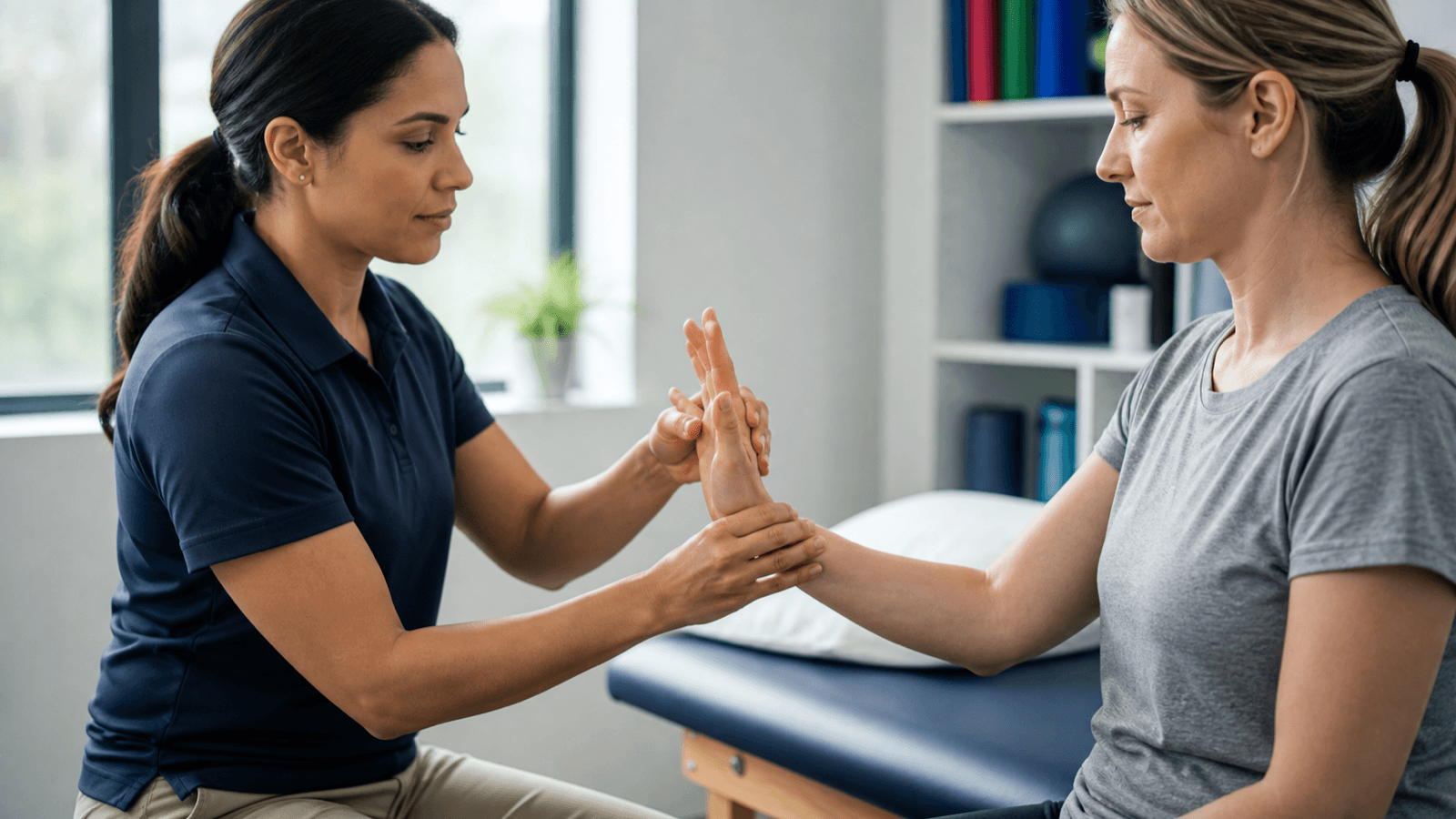
Physical therapy exercises for carpal tunnel syndrome are not optional add-ons — they are the foundation of conservative treatment. Structured PT addresses the root mechanical cause of median nerve compression inside the carpal tunnel, making it more effective than medication or bracing alone. Done consistently, these exercises reduce pressure on the nerve, improve wrist mobility, and can prevent the need for surgery in mild-to-moderate cases.
Last updated: April 2026
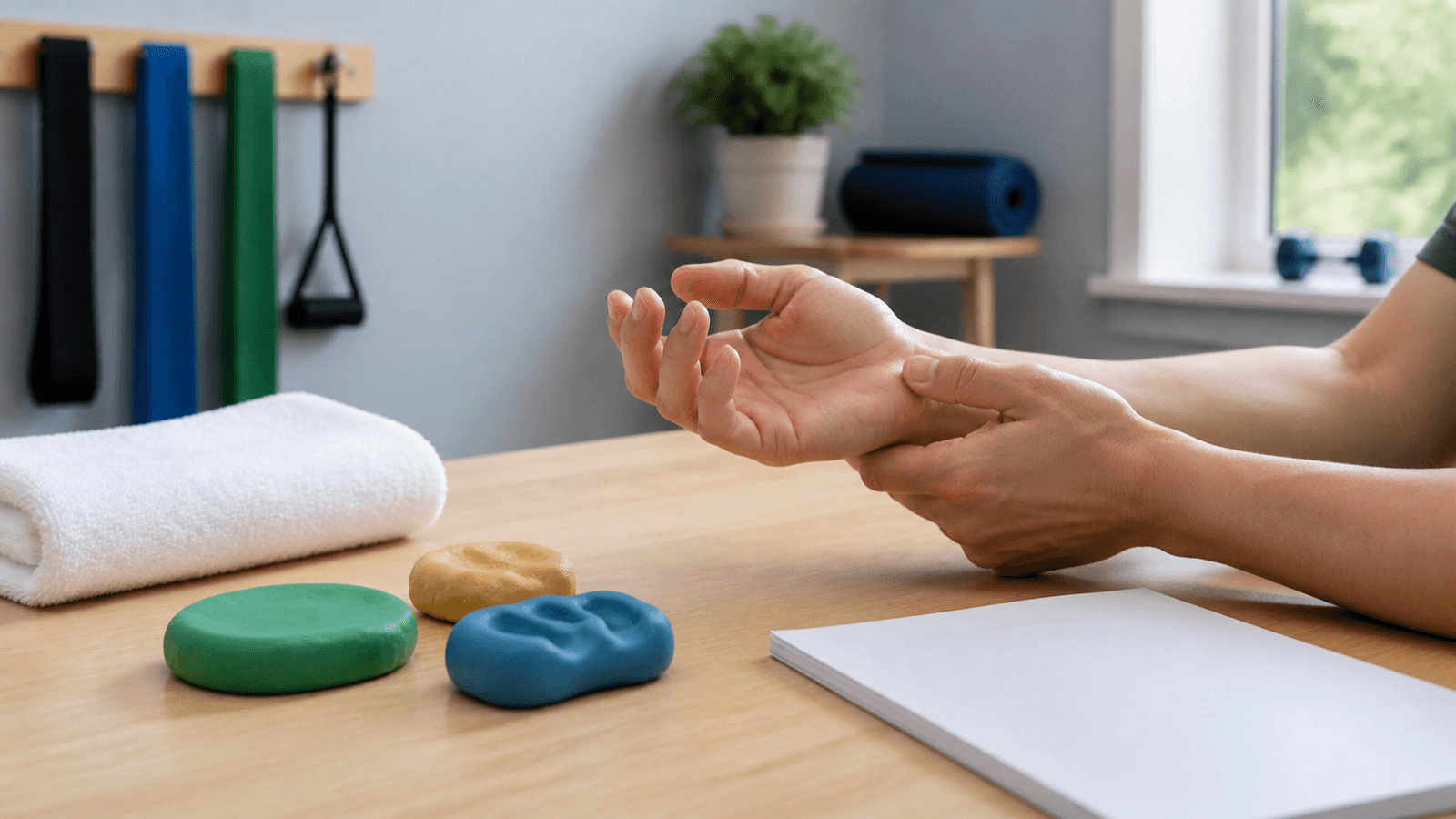
Table of Contents
- Why Physical Therapy Works for Carpal Tunnel
- Understanding the Anatomy: Why Mechanical Matters
- Understanding Median Nerve Gliding
- Wrist Extensor Stretches
- Tendon Gliding Exercises
- Grip and Pinch Strengthening
- Forearm Flexor Release
- Postural Correction Exercises
- Scapular and Shoulder Stability Work
- Progression and Regression: Adapting for Your Severity Level
- Building Your Daily PT Routine
- FAQs
- Sources & Methodology
Why Physical Therapy Works for Carpal Tunnel
Carpal tunnel syndrome is fundamentally a mechanical problem: the median nerve has insufficient space inside the carpal tunnel. Physical therapy addresses this through three mechanisms.
First, nerve gliding. The median nerve is not a rigid structure — it slides and stretches within its surrounding sheath as you move your arm and hand. When inflammation or compression restricts that sliding movement, pain and numbness result. Specific exercises restore nerve mobility by gently moving the nerve through its full range without compressing it.
Second, tendon mobilization. The nine flexor tendons that share the carpal tunnel with the median nerve glide through their sheaths with each finger movement. When those sheaths become inflamed or sticky, tendon movement creates friction that increases pressure inside the carpal tunnel. Tendon gliding exercises restore smooth tendon motion.
Third, muscular balance. The wrist extensor muscles — located on the top of the forearm — are often weak and lengthened in people with carpal tunnel (from prolonged keyboard work). Meanwhile, the flexor muscles on the underside are short and tight. This imbalance creates a constant pull toward wrist flexion, increasing pressure on the median nerve. Targeted extensor strengthening restores balance.
A 2019 systematic review in the Journal of Hand Therapy analyzed 12 randomized controlled trials and concluded that structured physical therapy for carpal tunnel syndrome produced statistically significant improvements in symptom severity and functional status scores — comparable to the results from splinting alone and without surgical risk.
Understanding the Anatomy: Why Mechanical Matters
To understand why PT works, it helps to know what you're treating. The carpal tunnel is a canal on the palm side of your wrist, approximately 1 inch wide and bounded by the carpal bones below and the flexor retinaculum above. Inside this space travel nine flexor tendons (that bend your fingers and thumb) and the median nerve (that provides sensation to your thumb, index, middle, and half of ring finger).
The tendons are encased in synovial sheaths — thin membranes that produce synovial fluid, allowing tendons to glide smoothly. When these sheaths become inflamed (from overuse, repetitive loading, or systemic conditions), they thicken and produce less fluid. The tendons glide less smoothly, creating friction against the walls of the carpal tunnel.
This friction raises the pressure inside the tunnel. Since the carpal tunnel is a fixed space, any pressure increase compresses the median nerve, which occupies about 25% of the tunnel's cross-sectional area. The nerve compresses first — causing numbness and tingling — and if the pressure is sustained, the nerve can sustain permanent damage.
Physical therapy targets this mechanical chain: inflammation reduces tendon glide, reduced glide increases pressure, increased pressure compresses the nerve. By reducing inflammation, restoring tendon glide, and improving nerve mobility, PT interrupts the cycle before permanent damage occurs.
Understanding Median Nerve Gliding
Nerve gliding exercises (sometimes called nerve flossing or neurodynamics) move the median nerve through its anatomical pathway without placing compressive loads on the carpal tunnel. The goal is to improve the nerve's ability to slide freely within its sheath, preventing adhesions and reducing referred symptoms.
The Science Behind Nerve Gliding
The median nerve originates from the lateral and medial cords of the brachial plexus (C5-T1 nerve roots), travels down the upper arm, passes under the Pec minor muscle, through the anterior compartment of the forearm, and into the hand through the carpal tunnel. Each segment of that pathway has some independent mobility. Nerve gliding exercises create controlled slackening and tensioning along the entire chain to maintain that mobility.
The nerve is designed to slide — it is not a rigid cable. But when inflammation in the carpal tunnel creates scar tissue around the nerve, that sliding is restricted. The nerve becomes tethered at the wrist, and arm movements that should glide the nerve freely instead pull on it, causing symptoms that seem to come from the hand but actually originate from the wrist or even the neck.
Safety Principles
These three rules govern safe nerve gliding:
- All movements are slow and controlled — never ballistic or fast
- Tingling or sharp numbness is a stop signal — back out of the position immediately
- During acute flares, perform glides in a pain-free range only
Median Nerve Glide Exercise (Detailed Protocol)
- Start with wrist in neutral, fingers and thumb in a relaxed fist
- Open the hand slowly, extending all fingers and thumb fully — the fingers should be straight but not hyper-extended
- As you extend the fingers, gently tilt your head away from the affected side (if working the right hand, tilt your head to the right)
- Hold at full extension for 2 seconds — you should feel a gentle stretch sensation along the inner arm, not pain
- Return to neutral fist and neutral head position
- Repeat 8-10 times, 3 times daily
Common mistake: Tilt the head in the same direction as the arm being exercised (e.g., both tilting right). This tensions the nerve at both ends and actually reduces the glide. The head tilts opposite the arm for maximum nerve slide.
Wrist Extensor Stretches
The wrist extensors are the muscles on the top of your forearm that pull your hand upward. They are functionally opposite to the wrist flexors — the muscles that curl your fingers and wrist downward and that are most implicated in carpal tunnel compression.
In people with carpal tunnel, the flexor muscles are typically short, tight, and overactive from sustained keyboard use. The extensor muscles are lengthened and weak from disuse. This creates an imbalance that constantly pulls the wrist into flexion — the position that compresses the carpal tunnel most severely.
Extensor stretches address the flexor side of this imbalance. By lengthening the flexors, the extensors no longer have to fight against a shortened opponent. The wrist can rest in neutral more easily.
Extensor Stretch 1: Pronated Forearm Stretch
- Extend your arm straight in front of you with palm facing down
- Make a gentle fist
- Use your opposite hand to gently press the back of your fist toward your body, feeling the stretch along the top of your forearm
- Keep your shoulder relaxed — do not hike your shoulder up toward your ear
- Hold for 30 seconds — you should feel a pulling sensation, not pain
- Release and repeat 3 times per arm
This stretch specifically targets the Extensor Digitorum Communis and Extensor Carpi Radialis longus/brevis muscles — the primary extensor muscles involved in wrist positioning during keyboard use. Keeping these muscles long and supple reduces the flexor-extensor imbalance that contributes to carpal tunnel pressure.
Extensor Stretch 2: Supported Wrist Extension
- Place your palm flat on a desk or table with fingers pointing forward
- Slowly lean your body weight forward, feeling a stretch across the top of your forearm
- Keep your shoulder back — do not protract your shoulder blade
- Hold for 30 seconds, breathing deeply — do not hold your breath
- Repeat 3 times per arm
This stretch is particularly effective after long computer sessions when your forearm extensors have been shortened by mouse use. Perform it every few hours as a counter to prolonged wrist flexion.
Extensor Stretch 3: Intrinsic Hand Interosseous Stretch
- With your arm extended and palm facing up, spread your fingers wide apart
- Use your opposite hand to gently press all five fingers toward your wrist (finger flexion) while preventing the wrist from bending
- This creates a deep stretch in the intrinsic hand muscles between the fingers and the carpal tunnel area
- Hold for 20-30 seconds, 3 repetitions per hand
Tendon Gliding Exercises
Tendon gliding exercises move each of the nine flexor tendons through its full range of motion without compressing the median nerve. Hand therapists developed these exercises specifically for carpal tunnel rehabilitation because they maintain synovial fluid circulation inside the tendon sheaths while reducing internal pressure on the carpal tunnel.
Gliding Sequence 1: Individual Finger Flexion
Perform this sequence slowly, holding each position for 3-5 seconds. Speed is not the goal — smooth, controlled motion is.
- Start with fingers extended straight up (like a scarecrow)
- Bend only the top joint of each finger, keeping the knuckles straight (making a hook shape)
- Now bend the middle joint of each finger while keeping the top joint straight (making a tabletop shape)
- Now make a full fist, flexing all joints
- Return to the start position slowly — the return is as important as the movement
- Repeat 5-10 times
This sequence moves each tendon independently, ensuring none adhere to surrounding tissue during the healing process. Adhesions — scar tissue that glues tendons to their sheaths or to each other — are one of the most common reasons carpal tunnel symptoms persist even after inflammation resolves.
Gliding Sequence 2: Composite Finger Flexion with Wrist Neutral
- Hold your hand in the prayer position (palms together, fingers pointing up)
- Spread your fingers apart wide
- Keeping fingers spread, slowly lower your hands to point your fingers at the floor (hands together, fingers pointing down)
- Now raise back to prayer position
- Spread fingers apart again and slowly lift to starting position
- Repeat 5-10 times
The wrist extension component at the end of this movement actually decompresses the carpal tunnel momentarily — creating a pumping action that moves synovial fluid out of the tendon sheaths. This is why the wrist extension is part of the glide rather than an external stretch.
Gliding Sequence 3: Finger Spread and Squeeze
- Start with all five fingers together
- Spread all fingers as wide as possible — hold for 3 seconds
- Squeeze all fingers together tightly — hold for 3 seconds
- Repeat 10 times
This exercise maintains the collateral ligament length of each finger joint. When fingers are held in flexed positions (typing, gripping), the collateral ligaments shorten. Shortened collateral ligaments restrict finger extension, making it harder to open the hand fully. Maintaining full finger spread capacity is part of comprehensive carpal tunnel rehabilitation.
Grip and Pinch Strengthening
Grip strengthening for carpal tunnel requires specificity. You should NOT strengthen the finger flexors (which compress the carpal tunnel). Instead, strengthen the wrist extensors and the thumb abductors — muscles that pull in opposite directions to the primary compressors.
Exercise 1: Wrist Extension with Theraband
- Sit with your forearm resting on a table, hand over the edge, palm facing down
- Loop a light theraband (yellow or red resistance) under your palm
- Slowly lift your hand upward against the band's resistance, moving only at the wrist — your forearm should stay on the table
- Lower slowly back to starting position (2 seconds up, 3 seconds down)
- Perform 12-15 repetitions for 2 sets
- Rest 60 seconds between sets
Progression: When 15 repetitions becomes easy (you can do 3 sets of 15 with no fatigue), increase to the next color resistance (green, then blue). Stronger resistance requires more extensor strength, which builds the muscular counterbalance to the flexors.
Exercise 2: Putty Grip for Thumb Abduction
- Use a small amount of therapeutic putty (soft resistance — start with tan or beige)
- Roll it into a small ball
- Squeeze the putty between your thumb and the side of your index finger
- Hold for 3 seconds, then release slowly — do not let the putty just drop from your grip
- Perform 10-12 repetitions for 2 sets
Thumb abduction strength is frequently diminished in people with carpal tunnel syndrome because the median nerve innervates the Opponens Pollicis and Abductor Pollicis Brevis. Preserving thumb function through targeted strengthening helps maintain hand independence and reduces compensation patterns.
Exercise 3: Marble Retrieval
- Place 10 small marbles or metal balls on a flat surface
- Pick up each marble one at a time using only your thumb, index, and middle finger (pincer grip)
- Drop each marble into a container beside the flat surface
- Retrieve all 10 marbles, then reverse direction (use the non-dominant hand to place, dominant hand to pick up, then swap)
- Repeat 2-3 times
This functional exercise mimics real-world pinch tasks while strengthening the median nerve-innervated thumb muscles without loading the carpal tunnel with heavy grip forces. The pincer grip is the opposite of power gripping — it activates the small intrinsic hand muscles rather than the large forearm flexors.
Exercise 4: Grip Strength with Rubber Ball (Modified)
- Use a soft stress ball (not a hard one)
- Squeeze gently — the movement should be slow and controlled
- Hold the squeeze for 3 seconds
- Release slowly
- Perform 10 repetitions — if this causes pain, stop and use a softer ball or skip this exercise
This exercise is only for people with mild symptoms. If you have moderate-to-severe carpal tunnel, skip this exercise or perform it very gently. The risk is loading the flexor tendons enough to increase inflammation.
Forearm Flexor Release
The forearm flexor muscles are a common site of trigger points (knots) that refer pain into the wrist and hand. Self-myofascial release using a tennis ball or lacrosse ball addresses these trigger points effectively.
The forearm flexor group is located on the inner side of your forearm — the side closer to your body when your arm is at your side. These muscles originate from the medial epicondyle of the elbow and extend down to the fingers and wrist. They are the muscles you use when you make a fist, type, or grip.
Trigger points in these muscles send referred pain patterns: the upper portion of the flexor mass refers pain to the inner elbow and upper forearm; the middle portion refers pain to the wrist and palm; the lower portion refers pain to the hand and fingers. Treating these trigger points with self-massage can reduce referred carpal tunnel symptoms that don't originate from the carpal tunnel itself.
Self-Release Protocol
- Lie face down with your forearm on the floor, palm facing up
- Place a tennis ball under the middle of your forearm, between the elbow crease and wrist
- Slowly roll your weight onto the ball, pausing on tender spots
- When you find a tender spot, make a fist and slowly open it 5 times while maintaining pressure on the spot — this contracts and releases the muscle around the trigger point
- Roll to the next spot and repeat
- Cover the entire forearm flexor group over 3-5 minutes per arm
Key areas to focus on:
- The medial epicondyle (inside of elbow) — common origin for flexor trigger points
- The mid-forearm (widest part of the forearm) — where the muscle bulk is greatest
- The distal forearm (closer to wrist) — where the muscle transitions into tendons
Do not release on the wrist crease itself — this is where the median nerve enters the carpal tunnel, and direct pressure here can worsen nerve symptoms. Focus on the muscle belly above and below the wrist crease.
Postural Correction Exercises
Carpal tunnel symptoms often originate not from the wrist but from upstream postural dysfunction. Forward head posture, rounded shoulders, and a depressed thoracic cage all increase tension on the median nerve before it even reaches the carpal tunnel.
This concept — neurodynamic interdependence — means that a nerve is only as mobile as its least mobile segment. If the cervical spine is stiff and the thoracic outlet is tight, the median nerve arrives at the carpal tunnel with already-limited mobility. Any additional tension from wrist flexion is more likely to create symptoms because the nerve has no slack to accommodate it.
Postural correction exercises address the upstream contributors to carpal tunnel symptoms.
Postural Correction 1: Chin Tucks
- Sit or stand with spine tall
- Gently draw your chin straight back (imagine making a double chin — the movement is horizontal, not downward)
- Hold for 5 seconds, keeping your eyes and nose level — your head should not tilt, just translate backward
- Release and repeat 10 times
Chin tucks strengthen the deep cervical flexors that counteract forward head posture. A forward head position increases the tension gradient along the entire median nerve chain, creating downstream pressure in the carpal tunnel.
Common error: Looking down while performing chin tucks. The correct movement is horizontal retraction — your nose stays level with the floor throughout.
Postural Correction 2: Wall Angels
- Stand with your back, head, and buttocks against a wall
- Place your arms against the wall in a goalpost position (elbows at 90 degrees, upper arms at shoulder height, palms facing forward)
- Slowly slide your arms upward along the wall, keeping full contact with the wall — arms eventually overhead in a Y position
- Stop when your arms are overhead or when your back loses wall contact
- Return to start position slowly — do not let your back arch away from the wall
- Perform 10-12 repetitions
Wall angels open the Pec minor and major muscles that, when tight, pull the shoulder girdle forward and downward. This releases the thoracic outlet compression that contributes to median nerve tension. The Pec minor is the most clinically significant median nerve compressor in the anterior chain — research from the Journal of Bodywork and Movement Therapies has confirmed this relationship.
Postural Correction 3: Thoracic Extension on Foam Roller
- Lie your back over a foam roller placed horizontally beneath your mid-back (not your neck)
- Support your head with your hands behind your head
- Gently arch backward over the roller, extending the thoracic spine — feel the expansion in your chest and the stretch between your shoulder blades
- Hold for 30 seconds, then roll slightly higher or lower and repeat
- Cover 3-4 positions over 2 minutes
Thoracic extension restores the natural kyphotic curve of the upper back, which influences shoulder and cervical posture throughout the day. When the thoracic spine is extended, the head can sit directly over the shoulders rather than forward of them, reducing the cervical tension that feeds into median nerve symptoms.
Postural Correction 4: Shoulder Blade Squeezes
- Sit or stand with arms at your sides
- Squeeze your shoulder blades together and down (imagine pinching a pencil between your shoulder blades)
- Hold for 5 seconds
- Release
- Repeat 15 times
This exercise activates the lower trapezius and rhomboid muscles — the muscles responsible for maintaining a neutral shoulder position. When these muscles are weak, the Pec major and Upper Trapezius dominate, pulling the shoulders forward and up, which increases thoracic outlet tension.
Scapular and Shoulder Stability Work
Beyond postural correction, the shoulder and shoulder blade play a direct role in carpal tunnel symptom generation through the median nerve's pathway. The shoulder blade (scapula) position influences the thoracic outlet — the space between the Pec minor muscle and the first rib where the brachial plexus (and median nerve) passes.
Scapular Setting Exercise
- Lie face down with arms at your sides
- Gently squeeze your shoulder blades down and toward your spine — do not lift your arms off the floor
- You should feel a subtle contraction under your shoulder blades
- Hold for 10 seconds
- Repeat 10 times
This exercise establishes proper scapular position before moving on to more advanced shoulder exercises. The key is learning to keep the scapula depressed and retracted without compensating with the upper trapezius.
Shoulder Flexion in Prone
- Lie face down with one arm hanging off the edge of a bed or table (affected side)
- Let your arm hang straight down, palm facing your body
- Gently lift your arm forward and upward, leading with the thumb (not the palm)
- Raise until your arm is at approximately 120 degrees of flexion or until you feel your shoulder shrug (stop there)
- Lower slowly
- Perform 10-12 repetitions for 2 sets
This exercise strengthens the lower trapezius and serratus anterior without loading the wrist — the arm moves freely at the shoulder, not the wrist.
Progression and Regression: Adapting for Your Severity Level
Not everyone should start with the same exercises. Carpal tunnel severity varies, and your PT routine should match your current status.
For Mild Symptoms (Occasional numbness, no weakness)
- Start with nerve glides, tendon glides, and postural exercises
- Add extensor strengthening with light resistance
- Full routine is appropriate
For Moderate Symptoms (Regular numbness, mild weakness)
- Focus on nerve glides and tendon glides (these are safest during moderate phases)
- Perform extensor stretches but hold for shorter durations (20 seconds instead of 30)
- Avoid heavy strengthening until symptoms improve
- Consider seeing a physical therapist for manual therapy
For Severe Symptoms (Constant numbness, visible weakness, thenar atrophy)
- Perform nerve glides in pain-free range only — no aggressive glides
- Focus on posture and positioning (how you hold your arm throughout the day matters more than exercise)
- Do not attempt strengthening — the risk of aggravating symptoms is too high
- Seek medical evaluation — surgery may be indicated
Building Your Daily PT Routine
The following routine takes approximately 15 minutes and covers all evidence-based exercise categories for carpal tunnel syndrome. Perform it twice daily for active symptoms, once daily for maintenance.
Morning Routine (10-15 minutes):
- Chin tucks: 2 sets of 10
- Wall angels: 2 sets of 10
- Shoulder blade squeezes: 2 sets of 15
- Nerve gliding exercises: 10 repetitions per hand
- Wrist extensor stretch: 3 sets of 30 seconds per arm
- Tendon gliding sequence: 5 repetitions
Evening Routine (10-15 minutes):
- Forearm flexor release with tennis ball: 3-5 minutes per arm
- Wrist extensor stretch: 3 sets of 30 seconds per arm
- Tendon gliding: 5 repetitions
- Composite finger flexion with wrist neutral: 5 repetitions
- Putty pinch or marble retrieval: 2 sets of 10
Consistency over intensity is the governing principle. A moderate daily routine outperforms an aggressive weekly one for carpal tunnel rehabilitation.
FAQs
What physical therapy exercises are most effective for carpal tunnel syndrome?
The most evidence-based PT exercises for carpal tunnel are median nerve glides, wrist extensor stretches, tendon gliding exercises, and grip strengthening for the wrist extensors. These exercises reduce pressure inside the carpal tunnel and improve median nerve mobility.
How often should I do carpal tunnel physical therapy exercises?
For maintenance and prevention, 10-15 minutes daily is sufficient. During active treatment of carpal tunnel symptoms, 3-4 sessions per day is more effective than a single long session. Consistency matters more than duration.
Should I do PT exercises if I am scheduled for carpal tunnel surgery?
Yes — pre-surgical physical therapy optimizes surgical outcomes by improving tissue pliability, maintaining range of motion, and strengthening compensatory muscles. Post-surgical PT recovery is faster when pre-surgical conditioning is in place.
Can I do these exercises during a carpal tunnel flare-up?
During acute flare-ups, perform only the nerve gliding exercises in a pain-free range, the extensor stretches gently, and avoid any resistive strengthening. Aggressive exercise during an inflammatory episode worsens symptoms. Resume full PT once acute inflammation subsides (after 48-72 hours of cold therapy and rest).
Do I need a physical therapist to guide me?
Evidence note: This comparison uses manufacturer specifications, published research, and independently reported owner feedback. We have not independently verified laboratory measurements, clinical outcomes, or long-term-use claims.
How long before physical therapy exercises reduce carpal tunnel symptoms?
Most people notice reduced morning stiffness within 1-2 weeks of consistent exercise. Measurable improvements in grip strength and symptom severity scores typically appear at the 4-8 week mark. Full benefit plateaus around 12 weeks of consistent practice.
Are there any exercises that make carpal tunnel worse?
Yes. Wrist curls with heavy weight, finger extension against resistance, and sustained gripping exercises (like excessive stress ball squeezing) increase flexor tendon loading and can worsen carpal tunnel symptoms. Avoid any exercise that creates sharp pain or tingling during or after performance.
Can physical therapy cure carpal tunnel syndrome without surgery?
For mild-to-moderate carpal tunnel syndrome, physical therapy combined with ergonomic modification and night bracing can fully resolve symptoms. For moderate-to-severe cases with chronic numbness and thenar muscle changes, surgery becomes necessary. PT in those cases still supports post-surgical recovery.
Sources & Methodology
- American Journal of Occupational Therapy. "Effectiveness of Physical Therapy for Carpal Tunnel Syndrome." ajot.aota.org. 2023.
- Journal of Hand Therapy. "Physical Therapy Interventions for Carpal Tunnel Syndrome: A Systematic Review." 2019.
- American Physical Therapy Association. "Carpal Tunnel Syndrome: Clinical Practice Guidelines." apta.org. 2024.
- Cleveland Clinic. "Carpal Tunnel Syndrome — Rehabilitation Exercises." my.clevelandclinic.org. 2025.
- National Institute of Neurological Disorders and Stroke. "Carpal Tunnel Syndrome Information." ninds.nih.gov. 2024.
- Journal of Bodywork and Movement Therapies. "Pec Minor and Median Nerve Tension." 2021.
Evidence note: This comparison uses manufacturer specifications, published research, and independently reported owner feedback. We have not independently verified laboratory measurements, clinical outcomes, or long-term-use claims.
Last updated: April 2026